Last Updated on October 27, 2026 by Dental Pathways
By Zahir Nathoo, Medical Tourism Facilitator
Medically reviewed by Dr. Can Atakan, Dentist | October 21, 2026

Choosing crowns in Turkey isn’t a matter of picking the prettiest or cheapest option off a menu. A dental crown is a medical treatment, and in full-mouth restorations it becomes a long-term investment in your health, one you’ll live with for years to come. Yet much of the dental tourism market sells crowns like a product: with prices per tooth, ‘5-star VIP packages’ and brand names like E-Max to make them sound like ‘premium’ purchases.
That approach to crowns in Turkey suits the high-volume clinics that dominate online searches, because it keeps patients focused on prices and brands rather than on asking the important questions. In reality, what truly decides whether a crown treatment lasts is the treating dentist, the materials chosen, the labs that manufacture the crowns, whether they’re joined together, and the preparation a tooth may need before it can be crowned in the first place. These rarely appear in the marketing, and often not even in the initial quote. Unfortunately, this leaves patients in the dark until they arrive in Turkey, and when something goes wrong, it usually shows up months after they’ve returned home, when it’s the hardest and most expensive to put right.
At Dental Pathways, we work exclusively with dentists who treat crowns as a matter of holistic care, not as a commodity. We’ve learned from our partners that dental treatment is nuanced, and that the crown itself is often the last and simplest part of the decision. This guide walks you through getting crowns in Turkey and everything that comes before it: the dentist and materials chosen, the main types of crowns available, when a tooth needs more than a crown, when keeping a tooth is better than replacing it with an implant, and how long the treatment really takes.
Wondering what crowns cost in Turkey?
See how crown prices in Turkey compare with prices at home, and what a full crown treatment really costs.
See Dental Crown CostsHow to Choose the Right Dental Crown Material for Your Teeth
There’s no single best crown material. The right dental crown materials for you depend on where they’re being placed in your mouth, the bite forces they have to withstand, your dental and medical history, and habits such as clenching or grinding. Many of the patients we speak with arrive convinced that zirconia always beats metal-porcelain, or that E-Max is the gold standard for every tooth. In reality, every material is only as good as the decision behind it: when and where it’s used, and how carefully it’s matched to the person wearing it.
A back molar in someone who grinds their teeth is a good example. It takes the heaviest forces in the mouth and is rarely seen when you smile, so a porcelain-fused-to-metal crown, strong and long proven, is often the best choice. A front tooth asks for something different, because it has to look natural as well as stand up to biting, and zirconia layered with porcelain often suits it better. And where a patient’s bite calls for strength throughout the mouth and the front teeth are being crowned in monolithic zirconia, there’s little reason to switch a handful of back teeth to metal-porcelain just for the sake of it. Dental treatment is as much an art as a science, which is why two treatment plans for the same patient can look different and both be right, something we explore in why dental treatment plans differ from one dentist to the next.
It’s also why the final choice should come from your dentist after an in-person examination, and not from something picked out of a brochure or a price list. A good dentist will listen to what you’ve read and what you’d prefer, then explain which material suits your case and why. Just as with implants, where the dentist’s expertise matters more than the brand, the skill behind a crown treatment matters more than the name of the material it’s made from.
Types of Dental Crowns: Pros and Cons
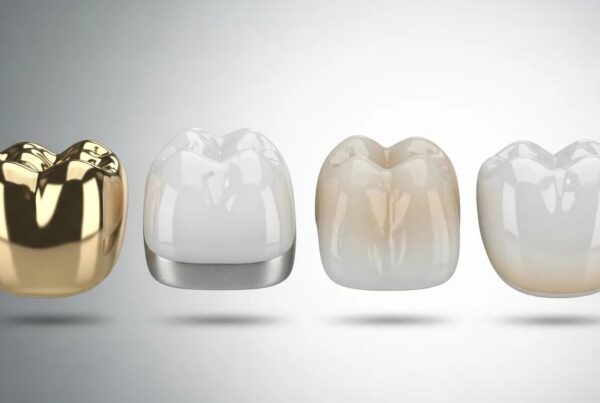
The four main types of dental crowns you’ll be offered in Turkey are porcelain-fused-to-metal (PFM), porcelain, zirconia-layered porcelain and monolithic zirconia. Each one balances strength and appearance differently, which is why each suits some teeth, and some patients, better than others. Here’s what each one is, where it works best, and the trade-offs that dental tourism marketing tends to leave out.
Dental crown types at a glance:
| Crown type | Strength | Appearance | Best suited to | Watch out for |
|---|---|---|---|---|
| Porcelain-fused-to-metal (PFM) | Very strong | Good; porcelain can wear over time, revealing metal at the gum line | Back teeth, longer bridges | Porcelain can chip or wear over time |
| Porcelain (e.g. E-Max) | Moderate | The most natural | Front teeth in patients who don’t grind or have a deep bite | More brittle under heavy bite forces |
| Zirconia-layered porcelain | Strong base, more delicate surface | Very natural | Front and back teeth in patients without heavy bite forces or clenching | Porcelain layer can chip in grinders |
| Monolithic zirconia | The strongest | Good when well made | Grinders, strong bites, full-mouth cases | Harder for the dentist to adjust chair-side |
Porcelain-Fused-to-Metal (PFM) Crowns
A PFM crown has a strong metal framework underneath and a layer of tooth-coloured porcelain fused over the top. It has been the workhorse of restorative dentistry for decades and still has the longest track record of any crown, particularly for back teeth and longer bridges, where the metal framework spreads biting forces across several teeth.
Pros:
- Strong under heavy bite forces, including across longer bridges.
- Predictable, long proven and usually the more affordable option.
Cons:
- Not the best choice for front teeth. Over time the porcelain layer can wear, chip or fade, and the gum can recede, revealing the metal underneath as a dark line along the gum. At the back of the mouth, where no one sees it, this rarely matters.
Porcelain (Ceramic) Crowns
A porcelain crown is made entirely of ceramic, with no metal or zirconia underneath. Its translucency lets light pass through it much as it does through natural enamel, which is why it gives the most natural look of any crown, and why it’s used mainly on front teeth.
Pros:
- The most natural look of any crown.
- Well suited to single crowns on front teeth.
Cons:
- Not as strong as metal or zirconia, so it’s more likely to chip or crack under heavy bite forces, especially on back teeth or in people who grind.
- Not suitable for longer bridges.
Zirconia-Layered Porcelain Crowns
A zirconia-layered crown is built in two parts: a strong zirconia framework (sometimes called a core or coping) shaped like a smaller version of the tooth, and porcelain that a technician layers over it to recreate the colour and translucency of a natural tooth. The zirconia provides the strength and the porcelain provides the looks, which makes these crowns a good ‘all-rounder’ for many patients.
Pros:
- Natural-looking results that are stronger than all-porcelain.
- Metal-free, so it avoids the aesthetic problems metal can cause over time.
Cons:
- The porcelain layer is the weaker point. Under heavy bite forces or grinding it can chip away from the zirconia beneath, which makes these crowns less suited to back teeth in people who clench or grind.
Monolithic Zirconia Crowns: The Strongest Dental Crown Material
A monolithic zirconia crown is milled from a single solid block of zirconia, with no porcelain layered on top. As a dental crown material, zirconia is among the strongest available (Nezir et al., Journal of the Australian Ceramic Society), and because there’s no separate porcelain layer, there’s nothing to chip away. For people with strong bite forces, or who grind their teeth, that matters more than almost anything else.
Monolithic zirconia is the right choice when a tooth needs real strength over time and still has to look good, such as the front teeth of someone who grinds heavily or whose whole mouth is being restored. But it’s the wrong choice when a clinic uses it simply because it’s cheaper and faster to mill in-house than to send the work to a skilled lab. Its strength and its appearance both depend heavily on the technician who designs and finishes it.
Pros:
- Extremely strong, with no porcelain layer to chip.
- Well suited to strong bite forces and people who grind their teeth.
- Better looking than PFM where strength is the priority.
Cons:
- Made without care, it can look flat and opaque, more like a white block than a tooth.
- Labs can improve its appearance by shading or infiltrating it before it’s fired (the pre-sintered stage) to make it more translucent, but this can reduce its strength, at which point a zirconia-layered crown may be the better option.
- Once fired, it’s very hard for the dentist to adjust in the chair, so the impressions must be accurate and the crowns made with real care. That matters even more when you can’t easily return to the clinic for adjustments.
Zirconia vs E-Max Crowns: Which Is Better?
When patients compare zirconia vs E-Max crowns, they’re usually comparing two different kinds of crown rather than two brands. E-Max is Ivoclar’s brand name for a lithium disilicate ceramic, and it became so well known that many patients now use “E-Max” to mean any all-porcelain crown or veneer, much as people say “Kleenex” for a tissue. Several other manufacturers make the same type of material under their own names, including Dentsply Sirona, GC and VITA. So the real question isn’t which brand is better, but whether a particular tooth is better suited to an all-porcelain crown or a zirconia one.
As Dr. Can Atakan, one of the dentists we work with in Istanbul and the medical reviewer of this guide, explains, the strengths and weaknesses of all-porcelain crowns come from the same source. “Because lithium disilicate doesn’t need a zirconia or metal structure underneath it, it gives the most natural, translucent look, closest to a real tooth,” he says. “For the same reason, it’s structurally more brittle and less resistant than crowns supported by zirconia or metal.” Zirconia is considerably stronger in laboratory testing and copes far better with heavy bite forces, grinding and bridges, although it has traditionally looked less translucent, a gap that newer high-translucency zirconia has narrowed (Zarone et al., BMC Oral Health).
That trade-off is why the choice depends so much on the person rather than the material. Dr. Can’s own rule of thumb is a good illustration: “If the patient doesn’t grind their teeth or have a deep bite, I recommend full porcelain for the front teeth, particularly in younger patients and those with weaker chewing muscles. But if the patient has a deep bite, grinds their teeth or has strong chewing muscles, directing them towards zirconia makes me feel more secure.”
In practice, that means all-porcelain is an excellent choice for veneers (see our guide to veneers in Turkey) and for front crowns on the right patient. Many of the crown cases we coordinate, though, involve back teeth, heavy bite forces or full-mouth restorations, often in people who have been grinding their teeth for years, and for those patients, zirconia or PFM is the more resilient option. The problem has never been E-Max itself, but the way dental tourism marketing has sold it as the premium choice for everyone, with little explanation of the patients and teeth it actually suits.
Dental Labs and Crown Quality: Why the “In-House Lab” Isn’t a Selling Point
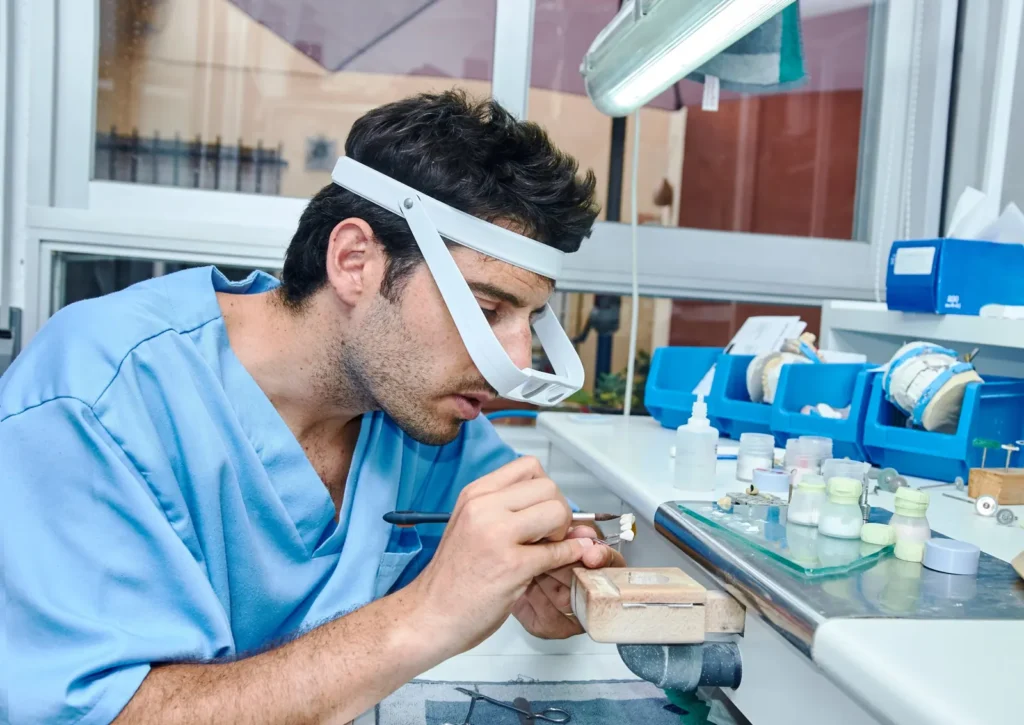
Many high-volume dental clinics in Turkey advertise their ‘in-house lab’ as a reason to choose them: everything under one roof, faster turnaround and lower prices. For anyone considering crowns in Turkey, what the advertising doesn’t mention is that an in-house lab is usually built for speed and volume, and that the quality of a crown depends far more on who makes it than on where it’s made. Your dentist prepares the tooth and fits the crown, but it’s a dental technician who designs it, mills it and, for layered crowns, builds up the porcelain by hand. That technician’s skill, and the equipment and materials they work with, decide how well your crown fits, how it looks and how long it lasts.
When a clinic’s business model depends on treating as many patients as possible, the lab is one of the first places costs are cut. Some labs use lower-grade zirconia blocks, or cheaper, lower-quality lithium disilicate sold to patients under the E-Max name. Others rely on inexperienced technicians, sometimes recent graduates, working to daily quotas. None of this is visible once the crown is in your mouth. A high-quality zirconia crown and a cheaper one can look identical on the day they’re fitted, and the difference only shows over the years that follow, in how well they hold up. We’ve written more about this in our article on All-on-X prostheses and the in-house lab question, where the same issue applies to full-arch dental treatments.
The dentists we work with don’t run in-house labs, on purpose. Instead, they choose to work with well-established dental labs that use the same leading material brands you’d find in labs in Canada, the UK or the US, and that employ experienced technicians who specialise exclusively in this kind of work. These labs can still turn crowns around in 24 to 48 hours, which is what makes it possible to complete most crown treatments in a single trip to Turkey.
Splinted vs Individual Crowns: Which Is Better?
Splinted crowns are two or more crowns joined together into a single connected unit, rather than placed on each tooth separately. Dentists sometimes call them linked or joined crowns. Splinting has a genuine clinical purpose in some cases, but many high-volume clinics splint crowns by default, simply because it’s faster and easier for them, and patients are rarely informed about it, or told that the choice has consequences.
Individual crowns behave much more like natural teeth. You can floss between them, each tooth can be cleaned properly at the gum line, and if one tooth develops a problem years later, your dentist can treat that single tooth and replace a single crown. Splinted crowns are harder to keep clean, because there’s no gap to floss through, and when one tooth in a joined section needs attention, the whole section may have to be cut off and remade. That turns a small, inexpensive repair into a much larger and costlier one, often with a dentist back home who would never have joined the crowns in the first place.
This isn’t a theoretical concern. Before one of our patients travelled, her dentist in Canada raised this question with us directly. She had treated several patients who came back from Turkey with all of their crowns joined together, something rarely done in Canada, and found that even routine work on a single tooth became complicated and expensive as a result.
That said, splinting is not always wrong. In fact, there are often situations where joining crowns is the best clinical decision, for example to spread heavy bite forces across several teeth or to give a weakened tooth extra support from its neighbours. The dentists we work with crown teeth individually wherever they can, splint them only when there’s a clinical reason to do so, and explain that reason to the patient before treatment begins. This is one of the considerations to explore with your dentist before a crown treatment.
Do You Need a Root Canal Before a Crown?
Not usually. Many people considering crowns in Turkey assume they’ll need root canals too, but most teeth that need a crown don’t need a root canal first, and many damaged teeth don’t need a crown at all. Treatment for a worn or damaged tooth sits on a spectrum, and a good dentist will recommend the least invasive option that will last:
- No treatment. Minor wear or small chips often need nothing more than monitoring.
- A filling. Where decay or damage is limited, a filling restores the tooth while keeping as much natural structure as possible.
- A crown. Where a tooth is cracked, heavily filled or significantly worn, a crown covers and protects what remains.
- A root canal, then a crown. Where decay or damage has reached the nerve but enough of the tooth remains to hold a crown, the nerve is treated with a root canal and the tooth is then crowned.
- A root canal, post and core, then a crown. Where damage or wear has reached close to the nerve and too little of the tooth is left to hold a crown, the tooth must be rebuilt before it can be crowned.
Not every damaged tooth needs a crown
Treatment for a worn or damaged tooth sits on a scale. A good dentist recommends the least treatment that will last.
- Your natural tooth
- Nerve
- Filling material (filling or core)
- Root canal seal and post
- Crown
- 1
No treatment
Minor wear or a small chip. Often just monitored at check-ups.
- 2
A filling
Limited decay or damage. A filling repairs it and keeps most of the tooth.
- 3
A crown
A cracked, heavily filled or worn tooth is shaped down and covered with a crown.
- 4
Root canal and crown
Decay or damage has reached the nerve, but enough tooth remains to hold a crown.
- 5
Root canal, post, core and crown
The nerve is affected and too little tooth is left. The tooth is rebuilt, then crowned.
That last step is reserved for the most severe cases, such as teeth worn down by years of grinding or broken down by repeated decay, but it’s worth understanding because it’s often what turns a simple crown quote into a much larger treatment. Think of it as building a house: you can’t put up a solid structure on a weak or missing foundation. The root canal removes the damaged nerve and seals the inside of the root, which also leaves the tooth hollow and more brittle. A small fibre-reinforced post is then placed into the sealed canal, not to strengthen the root but to act like a tent pole, giving the rebuilt tooth something to hold on to. Finally, a core of filling material is built up around the post into a solid tooth shape, and only then is there something strong enough to support a crown. In one patient’s full-mouth case we personally coordinated, twenty-one of twenty-eight teeth needed this full sequence before a single crown was fitted. At that point, it’s no longer a crown treatment but a full reconstruction, and it should be planned as such.
Why Extra Root Canals Can Save Travelling Patients Money
When a tooth is sensitive or close to the nerve, a dentist has a choice: treat the nerve now with a root canal, or leave it and crown the tooth, hoping it settles. For a patient who lives near their dentist, waiting can be reasonable, because if the tooth becomes painful under the new crown months later, they simply return for a root canal and a replacement crown.
For a patient who has travelled abroad for treatment, the same problem is far more costly. The root canal and new crown would usually be done by a dentist at home, often at several times the price per tooth they paid in Turkey, and the savings that made the trip worthwhile can disappear with one or two problem teeth. That’s why, for international patients, the dentists we work with tend to treat borderline teeth more thoroughly during the original treatment, rather than leaving problems to surface after the patient has returned home. It reflects an understanding of the time and money people invest in travelling for their care, and a treatment plan built around the patient’s long-term interests rather than the smallest possible quote. That’s one of the clearest signs that your dental team is on your side.
Why Your Treatment Plan Should List Possible Extra Treatments
Some treatment needs can only be confirmed once your dentist examines you in person. X-rays show a great deal, but they can’t reveal everything. If you have existing crowns, for example, the dentist can only assess the tooth underneath once the old crown has been removed. And whether a tooth needs a root canal often only becomes clear once it has been prepared for its crown and tested for sensitivity.
A well-prepared treatment plan accounts for this in advance. It lists the treatments that may be needed, such as root canals or posts, along with their price per tooth, so you know before you travel what could change and what it would cost. You then pay only for the treatment you actually need. Many clinics leave these possibilities out of their quotes entirely, and patients only learn about the extra work, and the extra cost, once they’re already in the chair in Turkey. Our guide to what crowns cost in Turkey explains what these additional treatments typically cost.
Can Crowns Restore Your Face Shape and Bite? Vertical Dimension Explained
Yes, in patients whose teeth have been severely worn down, full-mouth crowns can restore both the height of their bite and their facial appearance, but it has to be done gradually and carefully. When teeth wear down over many years, usually from grinding or clenching, the bite gradually collapses with them. The upper and lower jaws close closer together than they should, which dentists call a loss of vertical dimension. Over time, this can make the lower part of the face look shorter and older than it is, and it often comes with pain in the jaw joints and muscles, known as TMJ pain. (Our article on bruxism and teeth grinding explains how this damage builds up.)
Restoring that lost height can make a striking difference, both to how a smile looks and to how the jaw feels. But the muscles and joints have spent years adapting to the collapsed bite, and raising it too far, too quickly, can cause pain. That’s why the dentists we work with first set the new height using temporary crowns: provisional crowns made from a durable resin, which the patient wears while the permanent crowns are being made. Over several days, the dentist checks how the patient is coping with the new bite before the permanent crowns are designed to match it.
Most patients adapt well, and their permanent crowns are fitted during the same trip. Occasionally, a patient finds the change too much at once. In that case, the dentist reduces the height slightly, the patient returns home wearing their temporary crowns, along with a temporary night guard to protect them while sleeping, and comes back to Turkey a month or two later, once the jaw has adjusted, to have the permanent crowns made and fitted. This only arises in cases of severe wear and full-mouth restoration, and it can’t be fully predicted in advance, which is why an honest treatment plan explains the possibility before you book your trip. The same principle applies to full-arch implant treatment, as we explain in our guide to All-on-X prostheses.
Crowns vs Implants: When Saving Your Natural Teeth Is Better
In the crown vs implant decision, when a tooth’s root and the bone around it are relatively healthy, or can be saved with a root canal, crowning and keeping the tooth is usually better than extracting it and replacing it with an implant. It’s a choice more patients face than you might expect. Two of our recent full-mouth patients first contacted us asking for full-arch implants, an All-on-4 or All-on-6, believing that replacing every tooth was the cleaner, longer-lasting solution to a lifetime of dental problems.
After studying their scans, the dentists we work with recommended the opposite: keep every natural tooth that could be kept, and rebuild it. In one case, the treating dentist reviewed the question with several specialist colleagues before finalising the plan, and all of them reached the same conclusion. Their reasoning came down to four points:
- Healthy roots are worth keeping. Although the teeth had broken down above the gum line, the roots and surrounding bone were sound. There was no clinical reason to remove them, and extracting healthy teeth means major surgery with no medical upside.
- Natural teeth can feel. Your own teeth carry proprioception, the fine sensory feedback that tells you how hard you’re biting. That sensation is lost with implants, and once your natural teeth are gone, it can’t be recovered.
- Extraction is permanent. Keeping your teeth leaves every future option open, including implants later if they’re ever needed. Removing them closes most of those doors for good.
- Implants aren’t risk-free. They’re an excellent solution where teeth have genuinely been lost, but depending on a patient’s health, how they care for their implants and other factors, implants can develop problems of their own, including inflammation of the gum and bone around them (a condition known as peri-implantitis).
For patients travelling for treatment, there’s a practical difference too. The cost of the two approaches is sometimes similar, and crowns are frequently the cheaper of the two. But implants always require at least two trips to Turkey, because the implants need several months to heal into the bone before the final teeth can be fitted, whereas crown treatment can often be completed in a single trip.
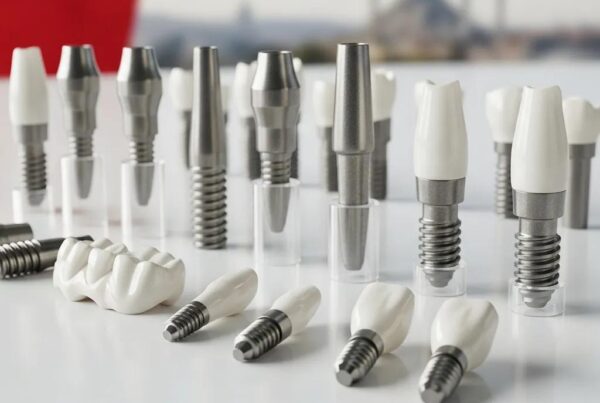
None of this makes implants the wrong choice. When teeth can’t be saved, implants are often the best possible solution, and our guide to dental implants in Turkey walks you through that path. The point is that the decision should come from your dentist’s examination of your teeth, not from the treatment you had in mind when you started searching. A clinic built around selling full-arch implant packages has every reason to recommend one, whereas a dentist focused on your long-term health may well advise you to keep what you have.
How Long Do Crowns in Turkey Take?
Getting crowns in Turkey typically takes about a week for crowns on otherwise healthy teeth, and around 10 to 14 days for full-mouth cases that also need root canals or a restored bite. In rare cases, where a large change to the bite needs time to settle, treatment is split into two trips a month or two apart.
For a straightforward case, the week usually runs like this. On the first day, the dentist examines you, confirms the plan and prepares your teeth, then takes impressions or digital scans for the lab. The next day, temporary crowns are fitted so you can eat and smile normally while your permanent crowns are being produced. Over the following days, you return for try-in appointments, where the crowns are checked in your mouth for fit, bite, shape and colour before they’re finished, with rest days in between. At the final appointment, your permanent crowns are cemented in place.
Larger cases follow the same pattern but take longer, for three main reasons. Root canals, posts and cores add long treatment days at the start of the trip. A restored bite height needs several days in temporary crowns before the permanent crowns can be designed. And full-mouth cases involve more crowns to try in and adjust. Well-planned treatment also builds in free days, so that any additional work found during treatment can be done without extending your stay.
The more thoroughly your dentist has reviewed your case before you travel, the more accurate your timeline will be. In one case, a patient’s early estimate of about a week grew to more than two weeks once a full examination and treatment plan had been completed, which is far better to discover before booking flights and accommodation than after. Rest days aren’t wasted time, either: they give your mouth time to recover, and give you a chance to explore Istanbul.
Protecting Your New Crowns: Why a Night Guard Matters
A custom night guard, which dentists call an occlusal splint, is one of the most important ways to protect new crowns, especially after a large restoration or if you clench or grind your teeth at night. It’s a removable appliance, made to fit your teeth precisely and worn while you sleep, usually on the upper jaw. It absorbs the forces of grinding and clenching so that your crowns, and the jaw joints, don’t have to.
For anyone who grinds, it isn’t an optional extra. The habit doesn’t stop just because your teeth have been restored, and without protection, your new crowns simply become the next surfaces to wear down or chip. That’s why we’ve included a custom night guard in the treatment plan for every large crown case we’ve coordinated. For one patient whose teeth had been ground down almost to the nerve, a night guard worn years earlier might well have prevented much of the damage that now needed repairing.
How Your Crowns Are Designed, Tested and Fitted: Working Closely With Your Dentist
Good crowns aren’t simply made and fitted. They’re designed, tested and refined, often over several appointments, through a close collaboration between your dentist, the lab technician and you. Each try-in appointment is a chance to check how the crowns feel when you bite, how their shape and length suit your face, and whether their colour and translucency blend naturally with your other teeth. If something isn’t right, the crowns go back to the lab to be adjusted, and they’re tested again until both you and your dentist are happy. Only then are they permanently cemented in place.
This is where the difference between a careful clinic and a rushed one becomes most obvious. In a high-volume setting, try-ins tend to be brief and adjustments kept to a minimum, because every extra appointment slows the schedule. The dentists we work with treat these appointments as one of the most important parts of the treatment, because once crowns are cemented, there’s little room left to change them.
You’re an active part of that process, not a bystander. The dentists we work with explain what they find and why they’re recommending each step before they act, and you’ll have time to ask questions, raise concerns or take a day to think things over. Nothing should happen that you haven’t agreed to. In return, it’s important to trust your dentist’s clinical judgement once they’ve examined your teeth in person, because some decisions, such as whether a tooth needs a root canal, can only be made in the chair.
Your dentist at home can play a valuable part too. In one case, a patient’s dentist in Canada examined her before she travelled and raised concerns about three particular teeth. Her treating dentist in Istanbul welcomed the input, reviewed those teeth with it in mind, and the patient’s treatment plan was better for it.
All of this starts before you travel. Speaking with your treating dentist, at least by video call, before you commit gives you the chance to understand the plan, ask questions and judge whether you feel confident in their approach. The video below explains why we consider this step so important.
Questions to Ask Before Getting Crowns in Turkey
Before committing to crowns in Turkey, it’s worth asking any clinic these questions:
- Which material do you recommend for each of my teeth, and why?
- Who makes the crowns, and do you use an in-house lab or an external one?
- Will my crowns be individual or splinted together? If splinted, why?
- Might any of my teeth need root canals, posts or other treatment before the crowns, and is that priced in my plan?
- Should any of my teeth be saved rather than replaced with implants?
- How long will I need to stay, and is there any chance I’ll need a second trip?
- Will I speak with my treating dentist before I travel?
- What happens if I have a problem after I return home?
A clinic that answers these clearly and in writing, before you’ve paid a deposit, is a reassuring sign that you’ve picked the right partner. Vague or rushed answers, on the other hand, are a warning sign worth taking seriously. If the quotes you receive are hard to compare, our article on why dental treatment prices in Turkey are so often confusing explains why.
Crowns, especially in a full-mouth treatment, are a long-term investment rather than a quick fix, and the difference between careful and careless work rarely shows on the day you fly home. Even rushed crowns can look perfect in the mirror at the airport. The problems tend to appear later: a tooth that starts aching under a crown a few months on, a splinted section that has to be removed because one tooth failed, or porcelain chipping in someone who was never given a night guard. Crowns done with care simply become part of your life, and that’s an outcome worth paying for.
That’s the kind of care Elif and I set out to make accessible when we founded Dental Pathways. We work only with dental partners we know and trust, and who have treated us personally, and we guide patients through every step, from the first consultation to support on the ground in Istanbul. If you’d like an honest opinion on your treatment options, get in touch with us!
About the Author
Zahir Nathoo is a medical tourism facilitator who has worked with dental patients from Canada, the UK and the US for over two years, connecting them with trusted, high-quality dental care in Turkey. He co-founded Dental Pathways with his wife Elif after his own family paid five times more for dental treatment in Canada.
Crowns in Turkey FAQs
Are crowns in Turkey safe?
Crowns in Turkey can be very safe, and the clinic you choose makes all the difference. Turkish dentists complete five-year university programmes followed by specialist training, and established clinics are accredited by the Turkish government and certified to treat international patients. The risks lie mainly with high-volume clinics that cut corners on materials, labs and planning. Speaking with your treating dentist before you travel, and asking how your crowns will be made, goes a long way towards avoiding them.
How much do crowns cost in Turkey?
It depends on the crown material, how many teeth are being treated and whether any of them need root canals, posts or other work first. A good treatment plan prices each of these per tooth before you travel, so nothing comes as a surprise in the chair. Our guide to dental crown costs in Turkey compares prices with those at home, by crown type.
Is zirconia a good dental crown material?
Yes. Zirconia is one of the strongest crown materials available, and monolithic zirconia has no porcelain layer to chip, which makes it well suited to people who grind their teeth. It isn’t automatically the best choice for every tooth, though. Porcelain-fused-to-metal is often a sound choice for back teeth, and zirconia layered with porcelain can look more natural at the front. Your dentist should choose the material best suited to your case.
Should I choose zirconia or E-Max crowns?
E-Max is a brand of lithium disilicate, the material used for most all-porcelain crowns and veneers. It gives the most natural look of any crown, which makes it an excellent choice for front teeth in patients who don’t grind their teeth or have a deep bite. Zirconia is stronger and the safer choice for back teeth, heavy bite forces and people who grind. Your dentist should recommend a material based on your bite, your chewing muscles and the position of each tooth.
Do all root canals need a crown?
Not always. A tooth that is still largely intact after a root canal can sometimes be restored with a filling alone. Teeth that are badly broken down usually need a post and core followed by a crown to protect them. For patients travelling for treatment, borderline teeth are often treated with a root canal before crowning, so that the nerve can’t cause pain under a finished crown after they’ve returned home.
Should I get a crown or an implant?
If a tooth’s root and the bone around it are healthy, keeping the tooth and crowning it is usually the better option, because you keep the natural feel of your bite and leave future options open. Implants are the right answer when a tooth can’t be saved. That decision should come from your dentist’s examination, not from a package price.
How long do I need to stay in Turkey for crowns?
Crowns on otherwise healthy teeth usually take about a week. Full-mouth cases that also need root canals or a restored bite typically take 10 to 14 days, and occasionally two trips a month or two apart. Your treatment plan should set this out before you book your flights.
What if I have a problem after I get home?
Minor adjustments can often be handled by your local dentist, and we can provide any information about your treatment that they request. For significant problems, Dental Pathways coordinates a return visit to the dentist who treated you.