
Last Updated on October 27, 2026 by Dental Pathways
Article by Ahmet Yildiz, Patient Coordinator, Dental Clinic, Istanbul.
Medically reviewed by Dr. Kıvanç Permuz, Dentist.
What Is All-on-X? Dental Implants Plus a Prosthesis
When patients travel abroad for All-on-X dental implants, they’re often promised a “full zirconia smile”: quick, flawless and permanent. Yet few realize how many different All-on-X prosthesis options exist, each with unique strengths and considerations.
All-on-X is a way of replacing a full arch of teeth. A small number of implants, usually four to six, are placed in the jaw, and a fixed set of teeth, the prosthesis, is attached to them. So every All-on-X treatment has two parts: the implants and the prosthesis. Our guide to dental implants in Turkey covers the implants and what treatment costs. This article focuses on the second part, the All-on-X prosthesis: the part you see, smile and eat with every day.
Most patients we meet are focused on the result, their new teeth. They are often satisfied by the promise that their new teeth will be made from “zirconia”. But there are many other options and zirconia is not a single, universal solution. It’s a material that can be used in several different ways, with varying designs, frameworks and performance outcomes. Each option comes with its own set of strengths, limitations and maintenance considerations.
We often meet patients who get their initial implants in Turkey (or elsewhere) but feel uncertain about the next phase: the prosthesis, the portion that replaces the teeth and restores full function. This guide to full arch dental implants will help you understand what your options really are, how they differ, and why the details matter.
All-on-4 vs All-on-6: How Many Implants Do You Need?
The “X” in All-on-X stands for the number of implants supporting each arch, most often four or six. Comparing All-on-4 vs All-on-6 isn’t about which is better in general. It’s about which suits your jaw.
All-on-4 is often used for patients with lower bone volume, or bone that isn’t evenly spread across the jaw. Four implants can be placed strategically where the bone is, and angled so they can still support a full arch. The trade-off is that fewer implants give the prosthesis less support. For some patients, however, that works.
All-on-6 is used when there is enough bone, evenly distributed across the jaw. Six implants spread the biting force over more points, so each implant carries less of the load. It’s also generally favoured for larger patients with stronger bite forces, who need more implants to support the prosthesis.
It’s also common for a patient to have All-on-4 on one arch and All-on-6 on the other, depending on the bone available in each jaw.
The prosthesis plays a part too. Its construction and weight affect how many implants it needs. The space available between your upper and lower jaw (your vertical dimension) can also determine which prosthesis types are possible in the first place. In other words, when approached correctly, the number of implants and the choice of prosthesis are decided together, case by case.
The All-on-X Treatment Process: What Happens on Each Trip
For most patients, All-on-X travel means two trips to Turkey:
- Trip 1 (about 5 days): your implants are placed and, within days (but not always), you’re fitted with fixed temporary teeth, so you go home with something in your mouth.
- Healing (3 to 6 months, at home): the implants fuse with your jawbone, a process called osseointegration, while the temporary teeth protect them.
- Trip 2 (usually 8 to 12 days): your final prosthesis is made and fitted. This is where the choices in this article come in.
Some patients need extra steps first. If the jawbone is too thin to hold implants, a bone graft or sinus lift can rebuild it. Sometimes the graft has to heal before the implants go in, which can mean a third trip.
You may also hear about immediate loading: fitting fixed teeth within days of implant surgery, instead of waiting months. It’s what clinics often market as “teeth in a day”, and it isn’t right for everyone. Whether it’s safe depends largely on how firmly the implants hold in the bone when they’re placed. For a step-by-step look at the timeline, temporary teeth and immediate loading, read our guide to what Teeth in a Day really involves.
Because the final prosthesis is made on the second trip, it’s worth understanding your options before the first one.
The Problem with “Big-Box” Dental Tourism Clinic Approaches
Understanding how these prostheses are built, and the differences between them, is the first step to gaining trust and confidence in your treatment plan and provider.
1. The Education Gap
Typically, the price quoted for All-on-X includes both the implants and the prosthesis. However, many large dental tourism clinics advertise “full zirconia” solutions without explaining what that actually means. In reality, there are multiple prosthesis types, each constructed differently, using different materials, and offering distinct advantages or drawbacks.
Many of these clinics take a one-size-fits-all approach, or leave clinical decisions to the last minute, so the patient never gets the education or a say. You end up with what the clinic decides to give you, without the transparency an informed patient would expect.
Unfortunately, most patients are never exposed to these nuances. Instead, they’re shown glossy before-and-after photos, promised quick results, and left with the impression that all zirconia prostheses are made the same.
The truth is that choosing the right prosthesis design determines not only how your smile looks but also how it feels and how long it lasts.
2. The In-House Lab Illusion
Many clinics market their “in-house lab” as a mark of sophistication and differentiation. In theory, it sounds impressive (a big operation with everything under one roof, right?).
Not exactly. In reality, most in-house labs are designed for speed and cost efficiency, not for the precision required to produce advanced restorations. They often rely on junior technicians using mid-range milling machines, producing prostheses that are adequate but not exceptional. Rather than expertise and differentiation, it’s a cost-cutting enterprise.
High-end prostheses, especially hybrid zirconia restorations supported by titanium bars, require advanced CAD/CAM milling systems and specialized technicians with vast experience that only dedicated, external laboratories possess.
That’s why, at Dental Pathways, we collaborate with clinics who work with labs that are equipped for complex, customized work, not mass-produced restorations. The video below explains how to choose a dental clinic in Turkey, so you can trust the work that’s being done.
Five All-on-X Prosthesis Options
Below, we break down the five most common All-on-X prosthesis options, how each is constructed, and when they’re used. They aren’t ranked from worst to best. Each has its own strengths and trade-offs, and depending on your bone, bite and anatomy, you may only be eligible for one or two of them. From there, the right choice is the one that fits your needs and budget. The differences lie not only in materials, but also in how each prosthesis is engineered and assembled.
1. Acrylic Hybrid Prosthesis (the “Hybrid Denture”)
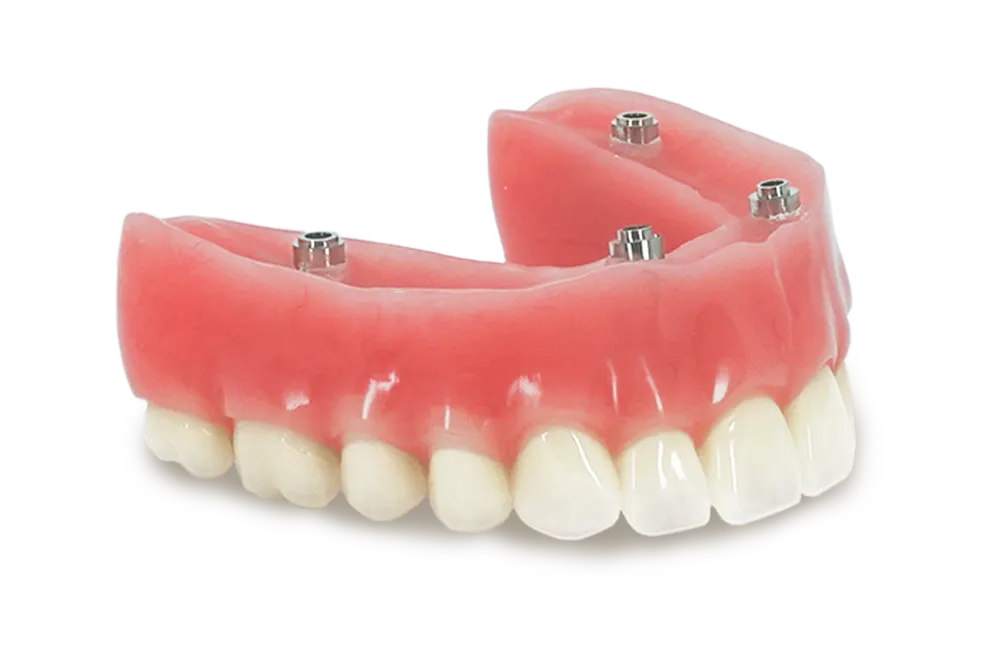
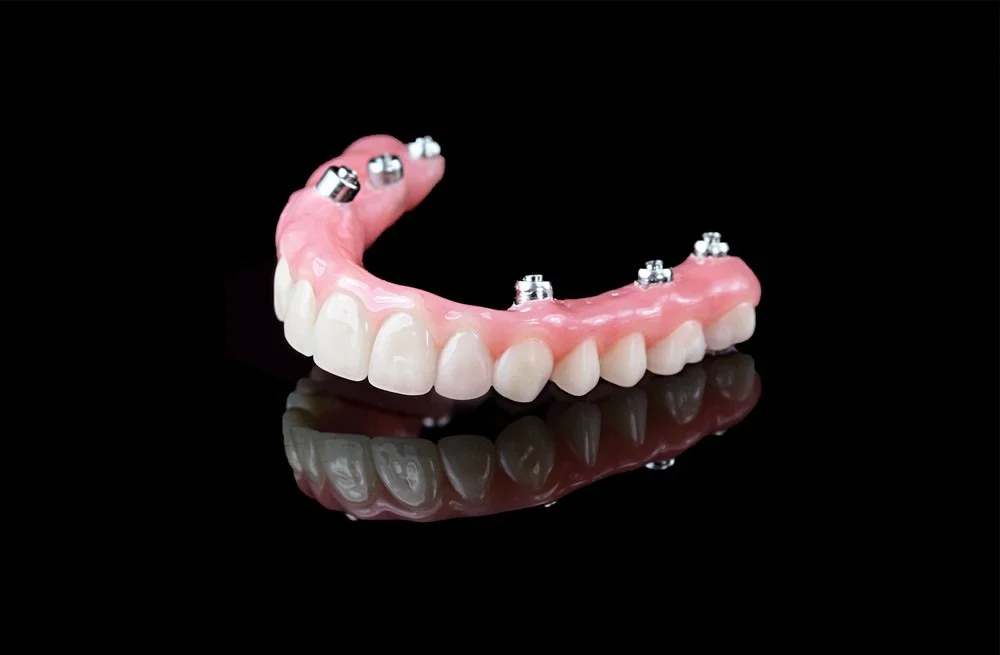
How it’s made: Acrylic teeth are set in a pink acrylic base that mimics the gums, and the whole piece is reinforced with a metal framework, most often a titanium bar and sometimes cobalt-chrome, that’s screwed onto the implants. In North America, it’s widely called a hybrid denture: it looks like a denture, but it’s screwed in place to your implants and doesn’t come out. It’s the entry point to fixed full-arch teeth, and the simplest type of hybrid prosthesis.
Advantages:
- Lightest of all the options.
- The most affordable way to get fixed full-arch teeth.
Disadvantages:
- The least durable option: acrylic teeth wear, chip and stain faster than ceramic or zirconia.
- Usually needs repairs or replacement sooner than the other options.
- Looks good from a distance but less natural up close.
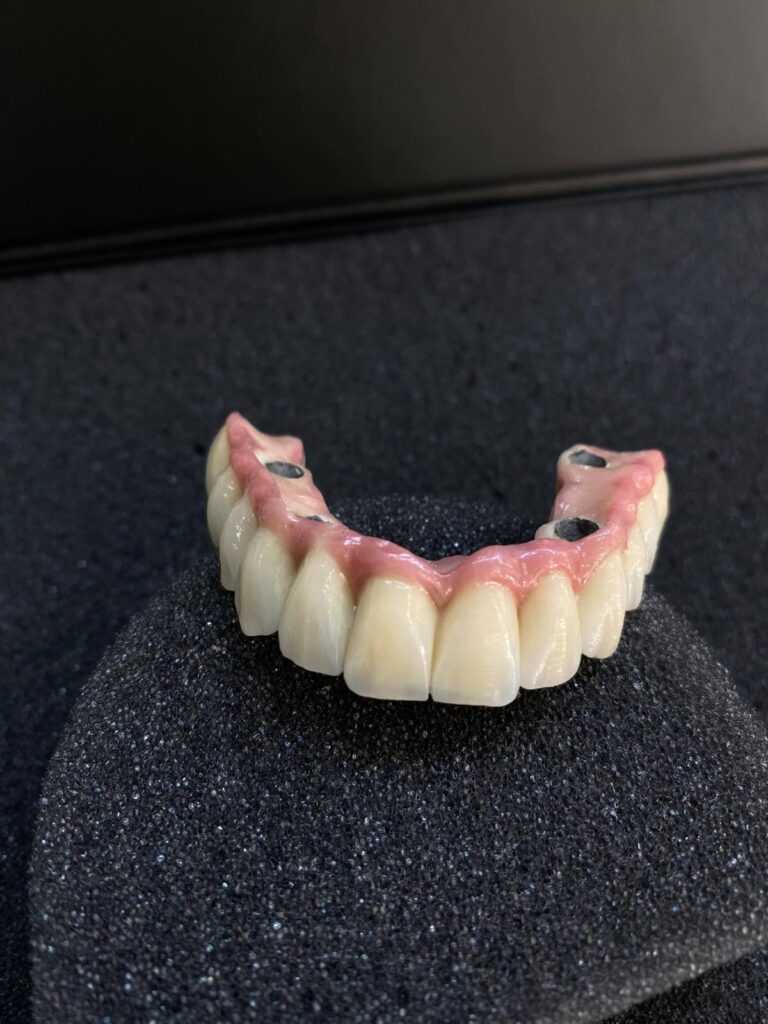
2. Metal-Ceramic Prosthesis (Traditional & Time-Tested Option)
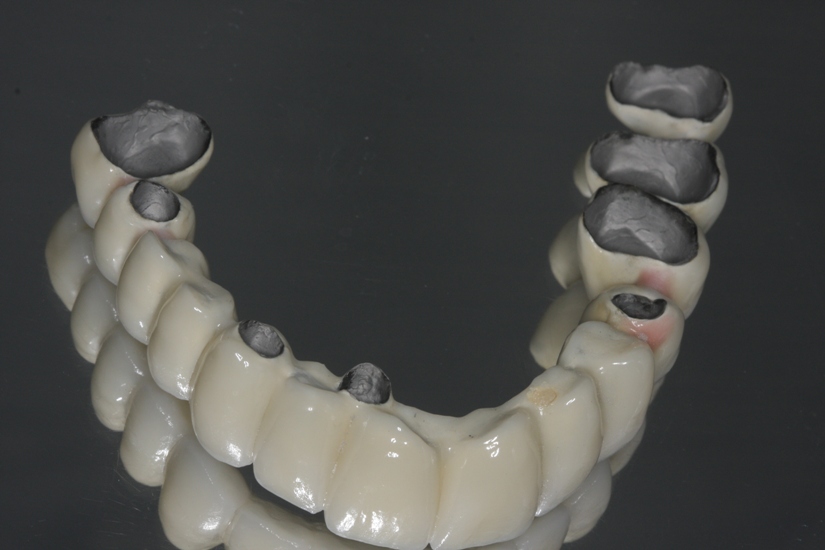
How it’s made: A metal framework (usually cobalt-chrome or titanium) is fabricated either manually or digitally. Layers of porcelain are then fused directly onto this framework through a high-temperature firing process. The entire structure, teeth and gums, becomes a single, solid unit.
Advantages:
- Strong metal substructure provides excellent support.
- Long-established and time-tested design.
- More affordable than zirconia or hybrid zirconia alternatives.
- The thin metal framework allows a comfortable fit and natural gum contour.
Disadvantages:
- Porcelain chipping can occur, especially in patients who grind or clench (bruxism).
- Repairs are difficult, often requiring a remake of the full arch.
- Esthetics are good but lack the translucency of zirconia.
- Heavier than other options.
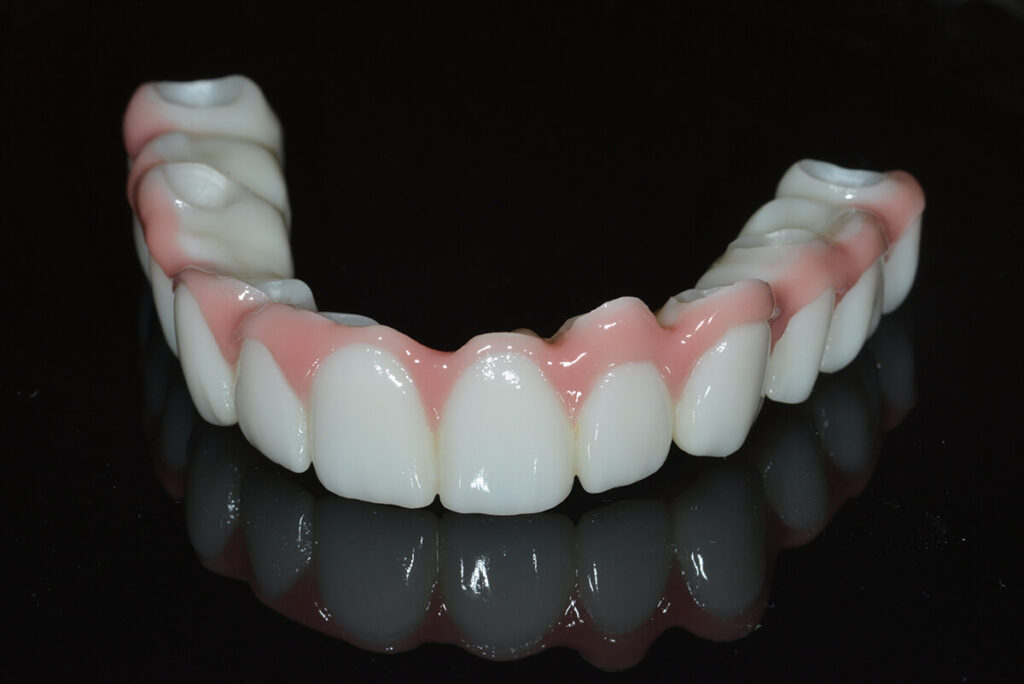
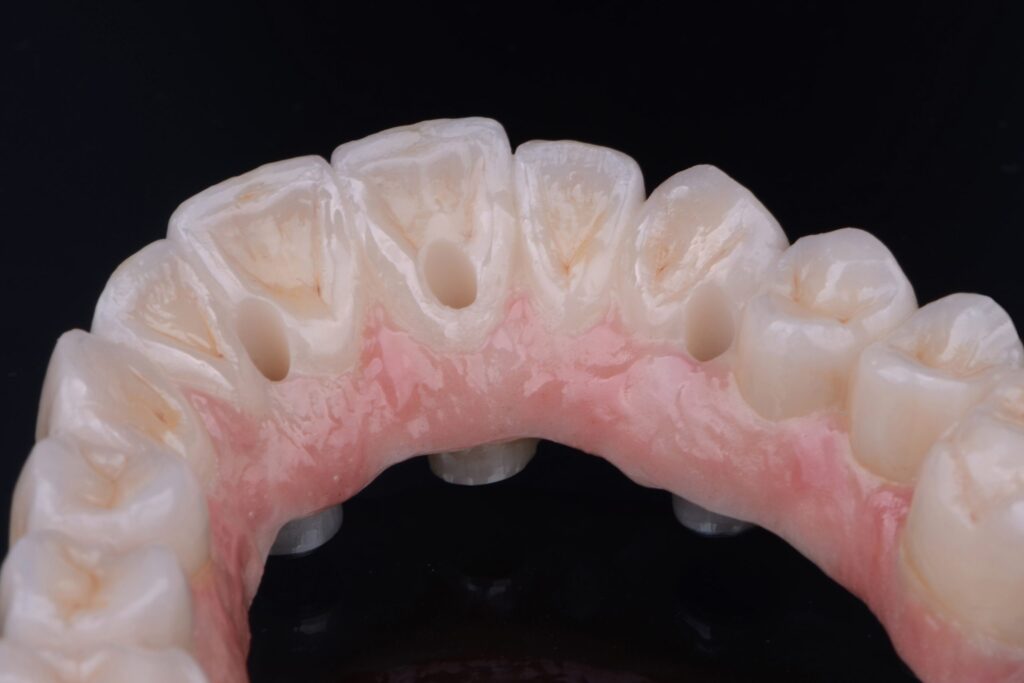
3. Monolithic (Full) Zirconia Prosthesis (Digital & Durable Option)
How it’s made: Designed fully in a digital workflow, the entire prosthesis, teeth and gum, is milled from a single block of solid zirconia. The surface is stained and glazed to mimic natural tooth coloration. When clinics advertise All-on-X zirconia, this one-piece design is usually what they mean.
Advantages:
- Extremely durable and fracture-resistant.
- High precision due to CAD/CAM design.
- No porcelain layering, which minimizes chipping risk.
- Very long lifespan when fabricated correctly.
Disadvantages:
- Repairs are not possible without full replacement.
- Very rigid, so it may cause wear on opposing natural teeth.
- Lack of cushioning can contribute to TMJ (jaw joint) discomfort if used on both arches.
- Thicker design may affect gum esthetics.
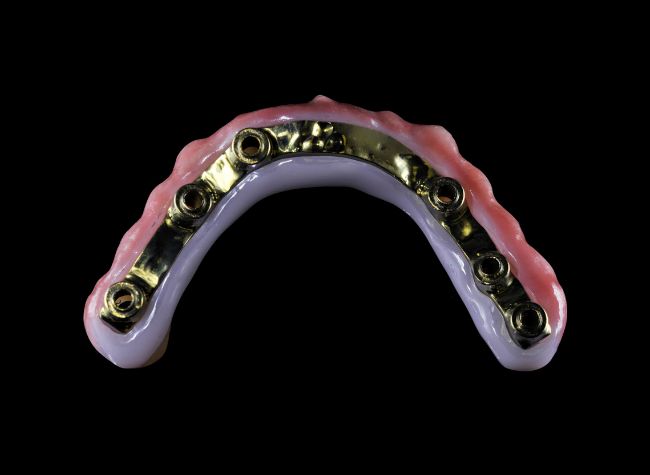
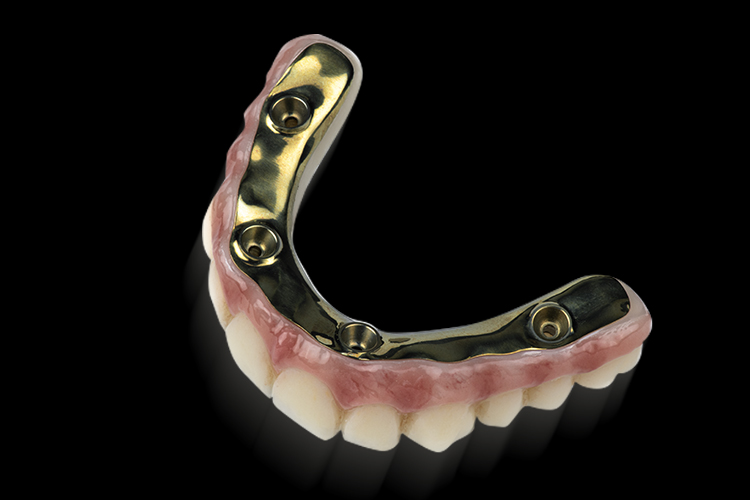
4. Hybrid Zirconia Prosthesis Supported by a Titanium Bar (Advanced Digital Solution)
How it’s made: A precision-milled titanium bar forms the structural foundation. A separate zirconia arch is milled to fit perfectly over the bar, and the two components are bonded together. This hybrid structure allows each material to do what it does best: titanium provides flexibility and shock absorption, while zirconia offers rigidity and esthetics.
Advantages:
- Superior strength and stress distribution.
- Lightweight yet durable.
- Reduces screw loosening and fractures.
- Highly esthetic and more comfortable for patients. Ideal for long-term function and stability.
Disadvantages:
- Complex to fabricate, requiring a specialized external lab.
- Slightly higher cost due to the materials and precision involved.
- Not offered by many high-volume clinics due to equipment limitations.
Titanium Bar vs Cobalt-Chrome Bar
The bars that support full-arch prostheses are usually made from titanium or cobalt-chrome. Titanium is lighter and very well tolerated by the body, and its slight flexibility helps absorb the shock of biting. That’s why it’s the bar of choice under a hybrid zirconia prosthesis, and a big part of what makes that design more durable. Cobalt-chrome is stiffer, heavier and often less expensive, and is common in metal-ceramic frameworks. Both are proven materials; the right one depends on the prosthesis design and your bite.
Video Resource: Full Zirconia vs. Titanium-Supported Hybrid Zirconia
In this short educational video, you’ll see a side-by-side comparison of two common full-arch prosthesis designs: a one-piece full zirconia restoration and a hybrid zirconia prosthesis supported by a titanium bar (T-bar). The animation demonstrates how these two structures differ in construction, strength distribution and esthetic characteristics.
It’s an excellent visual overview of why a titanium-reinforced framework can offer better stress absorption and durability than a monolithic zirconia design in certain cases.
Video by a third-party US dental provider, shared for education only. Dental Pathways is not affiliated with its creator.
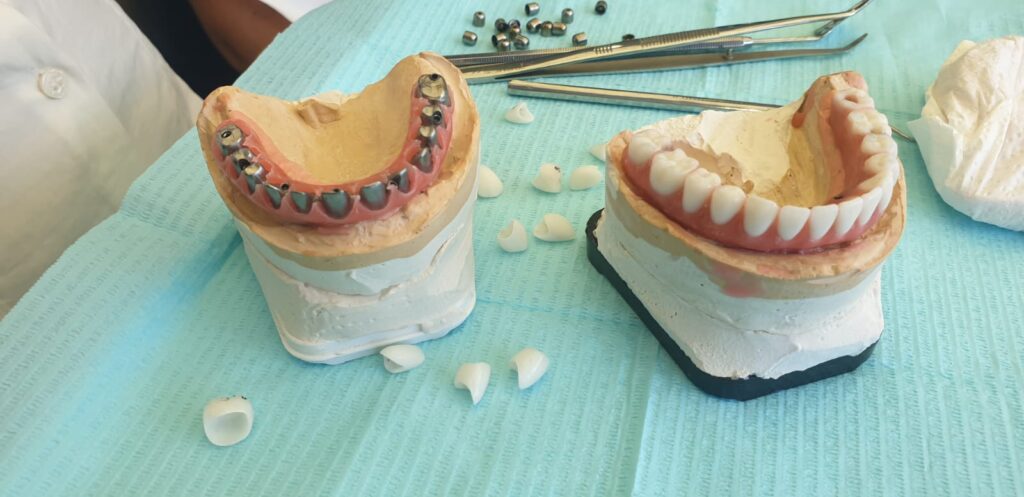
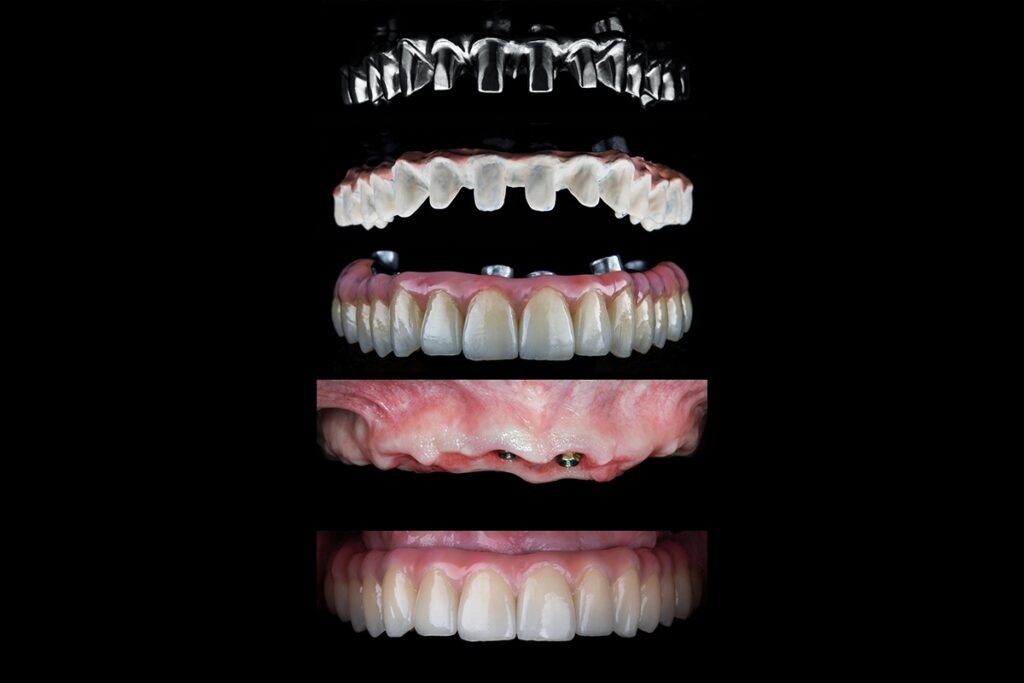
5. Toronto-Style Hybrid Prosthesis (Gold Standard Modular Design)
How it’s made: A custom titanium bar is milled with extreme accuracy and fixed to the implants. Then, individual zirconia or ceramic crowns are cemented separately onto the bar, often over a pink ceramic base that mimics gum tissue. Because each tooth is fabricated individually, this design requires close coordination between dentist and lab for a precise fit.
Advantages:
- Each tooth is individually replaceable if damaged.
- Outstanding esthetics and natural translucency.
- Excellent load distribution and bite comfort.
- Longest lifespan among all options when properly maintained.
Disadvantages:
- Most expensive and technically demanding option.
- Longer production timeline due to multiple lab stages.
- Not suitable for all patients; it depends on available space, vertical dimension and bite alignment.
Video Resource: Full Zirconia vs. Toronto-Style Hybrid Prosthesis
This video compares a full zirconia prosthesis with a Toronto-style hybrid design, where individually crafted crowns are mounted on a titanium framework. The demonstration highlights the structural and functional differences between the two, including how the modular, crown-based Toronto design allows for more precise customization, easier maintenance and more natural esthetics.
It’s a helpful reference for understanding why some advanced hybrid systems are considered the “gold standard” for long-term performance, depending on a patient’s bite alignment and vertical dimension.
Video by a third-party US dental provider, shared for education only. Dental Pathways is not affiliated with its creator.
Comparing All-on-X Prosthesis Options at a Glance
The table below summarizes the key features of the five All-on-X prosthesis options. It will help you visualize their distinctions across key features, such as framework design, repairability, esthetics and fabrication complexity.
Of course, it’s important to remember that real-world cases often vary. There are many ways to fabricate each type of prosthesis, and factors like the chosen materials, lab capabilities and the patient’s individual anatomy can influence both the process and outcome.
Still, this comparison offers a clear snapshot of the core structural and functional differences that help patients understand why no two prosthetic designs, or treatment plans, are ever exactly alike.
| Feature | Acrylic Hybrid | Metal-Ceramic | Monolithic Zirconia | Zirconia + Titanium Bar | Toronto-Style Hybrid |
|---|---|---|---|---|---|
| Framework | Titanium or Cobalt-Chrome Bar | Cobalt-Chrome / Titanium | Zirconia (one-piece) | Titanium Bar + Zirconia | Titanium Bar |
| Superstructure | Acrylic teeth and gums | Porcelain fused to metal | Solid zirconia | Zirconia bonded to titanium | Individual crowns on bar |
| Repairability | Easy, but needed more often | Difficult | Not repairable | Limited (bar reusable) | Excellent (individual crowns replaceable) |
| Durability | Lowest | Good | Very High | Very High | Very High |
| Esthetics | Moderate | Moderate | High | Very High | Exceptional |
| Weight | Lightest | Heavier | Lighter | Very Light | Very Light |
| Fabrication Complexity | Low | Low to Moderate | Moderate | High | Very High |
| Cost | Lowest | Lower | Mid-Range | Upper-Mid | Premium |
Repairs Far from Home: Why Repairability Matters More When You Travel
If your prosthesis chips in Vancouver and the lab that made it is in Istanbul, how it can be repaired matters far more than it would if the lab were down the street. For anyone planning All-on-X abroad, repairability is one of the most important factors, and one of the least discussed.
- Toronto-style: each crown can be replaced on its own, so one damaged tooth doesn’t mean a new arch.
- Hybrid zirconia on a titanium bar: if the zirconia arch fails, the bar can be reused and a new arch milled to fit it.
- Acrylic hybrid: chipped or worn acrylic can usually be repaired, but you’ll need repairs more often.
- Metal-ceramic: porcelain chips are difficult to repair and can mean remaking the full arch.
- Monolithic zirconia: it rarely chips, but if it breaks, the whole arch is replaced.
A common worry is that dentists at home won’t touch work done abroad. It’s often used as a scare tactic, and it isn’t true of every dentist in Canada, the US or the UK. Choosing a design that’s easier to maintain, and keeping full records of what was placed, makes follow-up care at home much simpler.
Choosing the Right All-on-X Prosthesis: It’s Not One-Size-Fits-All
It’s important to note that there isn’t a single “best” prosthesis for everyone. Each patient’s case is unique: factors such as vertical dimension, bite alignment, bone structure and even facial esthetics play a critical role in determining which design will deliver the best long-term result.
Your size and build matter too. Larger patients usually have a stronger bite force, which affects both the prosthesis design and how many implants are needed to support it.
What decides your All-on-X options?
Four factors narrow five prosthesis types down to the ones that suit you. It’s not a ranking: the right choice is the one that fits.
Four factors
- 1Bone volume and spreadHow many implants can go in, and where. Less or uneven bone often means All-on-4.
- 2Your size and bite forceA stronger bite needs more support, often All-on-6 and a sturdier framework.
- 3Vertical dimensionThe space between your jaws. Some designs need more room than others.
- 4BudgetOnce the clinical options are clear, cost helps you choose between them.
The five options
Often only one or two fit (example highlighted). That’s where you choose.
For some patients, a metal-ceramic design may offer the ideal balance of strength and fit. For others, a hybrid zirconia prosthesis or Toronto-style design may provide better load distribution or esthetic precision.
The goal isn’t to find the most expensive solution, but rather the most suitable one: one that harmonizes with your anatomy, function and expectations. That’s why careful evaluation by an experienced dentist and a qualified lab team is essential before selecting your final prosthesis.
It’s also why two dentists can look at the same mouth and propose different plans. Dentistry is both a science and an art, and we explore that in our guide on how to read and compare dental treatment plans.
Questions to Ask a Clinic in Turkey
Before you commit to treatment, ask:
- Which prosthesis type are you proposing, and why is it right for my case?
- Is the final prosthesis made in-house or by an external lab, and which one?
- Which materials will be used for the framework and the teeth?
- Are both the temporary teeth and the final prosthesis included in the price?
- How would a repair be handled once I’m back home?
A clinic that answers clearly, and without pressure, is a good sign. With Dental Pathways, you meet your dentist on a video call before you travel, so you can ask these questions directly.
Why Material Quality and Customization Matter
Even the best design can fail if the wrong materials or poor fabrication methods are used. The strength, precision and esthetics of your prosthesis depend heavily on both the materials and the laboratory behind it.
Cheaper materials may discolor, fracture more easily or fit poorly, leading to costly repairs or discomfort. High-grade zirconia and ceramics from established manufacturers, such as the Nacera® zirconia and GC ceramics used by our partner lab, provide proven strength, translucency and long-term stability. Equally important is lab flexibility: a skilled dentist should have the freedom to work with a trusted laboratory capable of producing the full range of prosthesis types. This ensures your restoration is tailored to your anatomy and not limited by a clinic’s internal constraints or cost-cutting policies.
At Dental Pathways, we only work with established clinics and laboratories that prioritize precision, customization and patient safety, not volume. When it comes to picking materials for dental crowns or full mouth restorations, we talk about the importance of quality and ethical dentistry in our article Crown Confusion: Dental Crowns in Turkey Explained.
Expertise and Integrity Make the Difference
Dental tourism doesn’t have to mean compromise. When comparing All-on-X quotes, the highest price isn’t always the best option. The key, rather, is choosing a team that values transparency, experience and long-term results over short-term profit. That includes choosing the right prosthesis for your unique case.
The prosthesis you choose is also one of the biggest drivers of your final price. For current prices in Canadian dollars, see our implant pricing guide.
At Dental Pathways, our goal is to help patients make confident, informed decisions about their All-on-X prosthesis options and long-term oral health. We collaborate exclusively with clinics that use high-quality materials, advanced lab partners and ethical treatment protocols, so you can focus on what matters most.
If you’ve already had implants placed and are unsure about your next step, or if you’re comparing treatment plans and want a second opinion, we’re here to help. We’ll review your case, discuss your prosthesis options, and connect you with trusted dental specialists in Turkey who share our commitment to patient-first care.
The promise of a “full zirconia smile” may sound simple, but achieving lasting results takes expertise, collaboration and integrity at every stage of the journey.
About the Author
Ahmet Yildiz is a Patient Coordinator at Dentevim Clinic in Istanbul, Turkey, where he specializes in supporting international patients throughout their dental treatment journey. With more than two years of experience in the dental sector and a professional background spanning finance, accounting, and project management, Ahmet helps patients navigate treatment planning, logistics, and communication with the clinical team. His work focuses on improving the patient experience by ensuring clear information, seamless coordination, and informed decision-making for those seeking dental care in Turkey.
All-on-X: FAQs
What does All-on-X mean?
All-on-X is a full-arch treatment where a fixed set of teeth is attached to a small number of dental implants, usually four or six per jaw. The “X” stands for that number. Every All-on-X treatment has two parts: the implants in the bone and the prosthesis that replaces the teeth. The prosthesis can be made in several ways, from acrylic to zirconia.
Is All-on-4 or All-on-6 better?
Neither is better for everyone. All-on-4 often suits patients with less bone, because the implants can be angled into the bone that’s available. All-on-6 spreads biting force over more implants and is used when there’s enough bone across the jaw, and often for larger patients with a stronger bite. Some patients have one of each, and your dentist decides based on your scans.
What is a hybrid denture?
A hybrid denture is a fixed set of acrylic teeth and gums attached to a bar on dental implants. It looks like a denture, but it doesn’t come out. It’s the lightest and most affordable All-on-X option, but also the least durable, so it usually needs repairs or replacement sooner than other options.
Is zirconia or acrylic better for All-on-X?
Zirconia is much stronger, looks more natural and lasts far longer. Acrylic is lighter and cheaper, and works as an entry-level option. Zirconia also comes in several designs, from one-piece arches to hybrids on a titanium bar, each with its own trade-offs.
How long does an All-on-X prosthesis last?
It depends on the material, the design and how well it’s cared for. Acrylic prostheses wear fastest and need work soonest, while well-made zirconia and Toronto-style designs can last many years longer. Grinding or clenching shortens the life of any prosthesis, which is why a night guard is often recommended. Regular check-ups and cleaning keep both the implants and the prosthesis healthy.
Can an All-on-X prosthesis be repaired if it breaks?
It depends on the design. Toronto-style crowns can be replaced one at a time, and a titanium bar can be reused under a new zirconia arch. One-piece zirconia and metal-ceramic arches usually need full replacement if they break, while acrylic can usually be repaired. If you’re having treatment abroad, it’s worth weighing repairability before you choose.
How many trips to Turkey does All-on-X take?
Most patients need two trips. The first takes about 5 days, for the implants and temporary teeth. After 3 to 6 months of healing, the second trip usually takes 8 to 12 days, for the final prosthesis. A third trip is sometimes needed, for example when a bone graft or sinus lift needs extra time to heal.
Titanium bar vs cobalt-chrome bar: which is better?
Both are proven materials. Titanium is lighter and slightly more flexible, which helps absorb biting forces, so it’s the usual choice under a hybrid zirconia prosthesis. Cobalt-chrome is stiffer, heavier and often less expensive, and is common in metal-ceramic frameworks. The right one depends on the prosthesis design and your bite.





Very nice article,exactly what I was looking for.
That’s good to hear! Let us know if you need any support on dental treatments in Turkey. Cheers.