Last Updated on October 29, 2026 by Dental Pathways
Written by Ahmet Yildiz | Medically reviewed by Dr. Kıvanç Permuz
If you’ve started looking into the dental crown cost in Turkey, you’ve probably already seen the headline numbers: crowns from around €150 (CAD 235) per tooth in Istanbul, against CAD 1,800 or more at home in Canada. It’s a striking difference, and for many of the people who contact us, it’s what first made treatment abroad feel possible. In our experience, though, the price of a single crown is rarely what decides whether your treatment is good value. What matters just as much is which crown each of your teeth actually needs, what your quote includes and leaves out, and what the whole trip costs once flights and accommodation are factored in.
At Dental Pathways, we’ve spent years preparing treatment plans and quotes for patients from Canada, the UK and the US. Most of our patients are Canadian, so we compare prices in Canadian dollars, but the same questions apply wherever you’re starting from. This guide sets out what you can expect to pay, why quotes vary so much, and what a good crown treatment quote should include before you book anything.
Key takeaways
- Crowns in Turkey cost from €150 (CAD 235) for PFM to €240 (CAD 380) for E-Max per tooth: 79 to 87% less than the CAD 1,800 or more you’d pay in Canada.
- The most overlooked variables will be whether you need fillings and/or endodontic treatment (i.e. root canals), a night guard and travel – not just the type of crown material you choose.
- From two crowns, the savings cover the cost of the trip, with room to spare for unexpected expenses. For slightly more treatment, once flights and hotel are included, patients can expect to save about 70% on average.
What crown material do I need?
This article covers prices. But before deciding on price alone, it helps to know what kind of crowns your teeth actually need and why. Our guide to crowns in Turkey explains the materials, clinic best practices that make crowns last, and questions to ask before you book.
Read Crowns in Turkey ExplainedHow Much Are Crowns in Turkey? Prices by Crown Type
Crowns in Turkey cost between CAD 235 and CAD 380 per tooth through Dental Pathways, depending on the type of crown. That’s a saving of up to 87%. The table below shows the types of dental crowns cost side by side.
| Crown type | Turkey | Canada | Savings |
|---|---|---|---|
| Porcelain-fused-to-metal (PFM) | €150 / $235 | $1,800+ | ~87% |
| Zirconia layered with porcelain | €198 / $310 | $1,800+ | ~83% |
| Monolithic zirconia | €215 / $340 | $1,800+ | ~81% |
| E-Max (lithium disilicate) | €240 / $380 | $1,800+ | ~79% |
| Root canal (per tooth, if needed) | €168 / $265 | $757 to $1,635 | ~65 to 84% |
| Custom night guard | €192 / $300 | $633 | ~53% |
$ = Canadian dollars. Canadian prices from the Ontario fee guide and real patient quotes.
You’ll notice that the difference between the zirconia crowns is small. What matters far more than the material’s price is whether it’s the right material for each tooth and what kind of dentist you’re working with.
Does a Front Crown Cost More Than a Back One?
The front crown cost isn’t necessarily higher because of the tooth’s position. It depends on the material the tooth needs, and front and back teeth usually need different approaches. A back molar takes the heaviest biting forces and is rarely seen, so a strong porcelain-fused-to-metal crown is often the right choice. A front tooth has to look natural as well as work properly, so zirconia layered with porcelain, or all-porcelain for the right patient, often suits it better.
In practice, that means some patients end up with two types of crown materials in the same mouth, and their bill reflects it. This isn’t a strategy to save money on the back teeth. It’s simply how good dentistry plays out: each tooth gets the crown that suits it, and because PFM costs less, patients often pay less overall than they would if every tooth were crowned in the same premium material.
Is E-Max Worth Paying More For?
Not by default. E-Max is a brand name for lithium disilicate, an all-porcelain material that gives a beautifully natural look on the anterior (front) teeth. But dental tourism marketing has turned it into a shorthand for ‘premium’, and many patients ask for it, and pay more for it, on teeth where a stronger crown would serve them better. A good dentist will tell you where it fits and where it doesn’t.
The research supports this. A review of the two materials found zirconia considerably stronger than lithium disilicate under heavy bite forces, while lithium disilicate offers the more natural translucency (Zarone et al., BMC Oral Health).
 Limited-time offer
Full-arch crowns at €135 per crown
CAD 215 per crown · For treatment plans of 10 or more crowns.
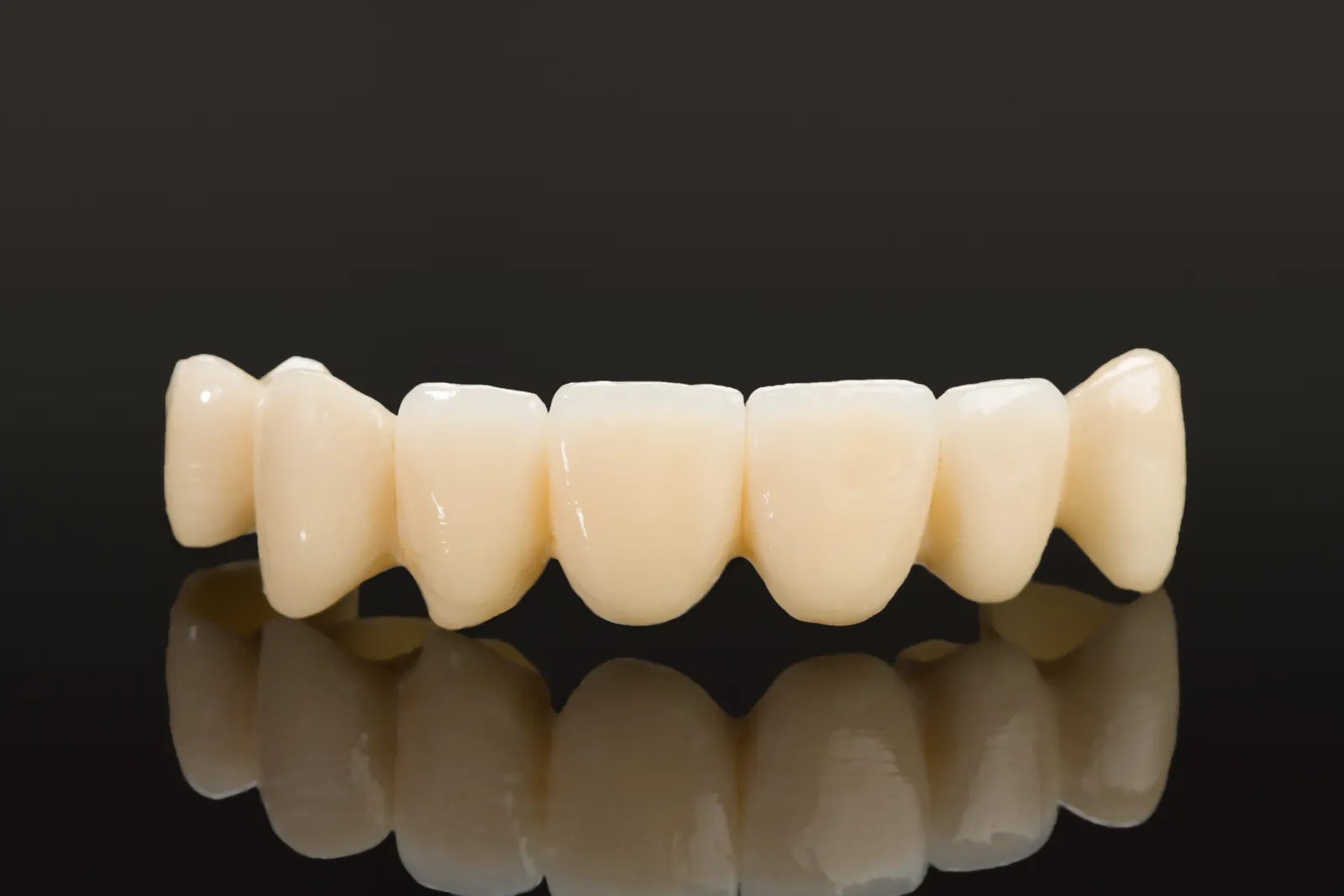
All-porcelain · Layered zirconia · Monolithic zirconia
Included: all X-rays, temporary crowns and materials
E-Max crowns and plans under 10 crowns at regular prices. Endodontic treatment (root canals) charged separately. Valid until 28 February 2027.
Materials from Ivoclar Vivadent, GC and Bego, with Nacera zirconia.
How Much Does a Dental Crown Cost in Canada?
The dental crown cost in Canada usually starts at around CAD 1,800 per tooth, and for many patients it ends up well above that. That’s the figure we see again and again on the Canadian quotes our patients share with us, and it’s higher than the provincial fee guides suggest, for reasons worth understanding.
Each province’s dental association publishes a suggested fee guide: a list of procedure codes with a recommended fee for each. Ontario’s is the highest in the country. Under the Ontario Dental Association fee guide, a porcelain or ceramic crown is listed at CAD 1,167, plus a dental lab fee of CAD 250 to 350, for a total of roughly CAD 1,417 to 1,517. Atlas Dental, a Toronto clinic, publishes a clear breakdown of the Ontario guide if you’d like to see the codes for yourself.
A fee guide, though, is where pricing starts, not where it ends. Lab fees vary widely, and real treatment plans tend to pick up extra line items along the way: examinations, X-rays, scans, temporary crowns, build-ups and adjustments. That’s why the quotes we see in practice rarely come in under CAD 1,800 per crown.
Against that CAD 1,800 floor, crowns in Turkey cost 79 to 87% less, depending on the type of crown.
One thing Canadian fee guides don’t do is price crowns by material. A porcelain crown and a porcelain-fused-to-metal crown carry the same fee, and nothing separates zirconia from E-Max. Patients are expected to trust their dentist to choose the right crown for each tooth. We think that’s exactly how it should be. The difference is that in Turkey, you can have that same trust in a skilled dentist at a far more reasonable price.
The gap widens when a tooth needs a root canal first. In Ontario, root canal treatment is listed at CAD 757 to 1,635 per tooth, depending on how many canals the tooth has. A single tooth needing a root canal and a crown can therefore cost roughly CAD 2,200 to 3,150 in Canada, compared with about CAD 500 in Turkey.
Why Are Crowns Cheaper in Turkey?
Crowns cost less in Turkey because the cost of running a dental practice there is far lower, not because the materials or training are worse. Rent, staff salaries, lab costs and everyday overheads are a fraction of what a Canadian clinic pays, and the exchange rate works strongly in the patient’s favour. Turkey has also invested heavily in health tourism over the past two decades, which has created a large pool of experienced dentists and well-equipped labs used to treating international patients.
The dentists we work with use the same leading material brands you’d find in Canada, the UK or the US. What you’re saving on is the cost of the system around the treatment, not the treatment itself. We explore these structural reasons in more depth in why Turkey is a leader in high-quality, affordable dental care.
Why Do Crown Prices in Turkey Differ So Much Between Clinics?
Crown prices in Turkey differ because clinics are often pricing different things, even when they use the same words. One clinic’s ‘zirconia crown’ may come from a high-volume ‘in-house lab’ cutting corners to meet daily quotas; another’s from an established external lab with experienced technicians. One quote may include the diagnostic scans, temporary crowns and the night guard you’ll need; another may leave them out until you land in the chair in Turkey! And one clinic may splint your crowns together to save time, while another crowns each tooth individually. We explain this variability in pricing in why dental treatment prices in Turkey are so confusing.
Dentists also differ in how they approach the same mouth. Two honest treatment plans for the same patient can look different and both be right, because dentistry involves clinical judgement as well as technique. What matters is whether the plan has been built with integrity around your specific case or aggressively marketed to you like a product. Learn how to tell the difference in the article how to read and compare dental treatment plans.
Splinting is one example worth knowing about. Many high-volume clinics join three to six crowns together as a single unit, because it’s faster and easier for them. When splinting is genuinely needed, the dentists we work with join two crowns at a time, which gives the right balance of support and flexibility. Otherwise, they crown each tooth individually, which makes future repairs simpler and cheaper. This is worth knowing when trying to understand the ‘value’ of the savings you’re getting in Turkey – and finding the right dentist makes all the difference.
What Does the Whole Trip Cost?

For most patients, the trip pays for itself from two crowns. A return flight from Canada to Istanbul costs about CAD 1,200, and a mid-range hotel in central Istanbul about CAD 100 a night, so a typical five-night trip comes to around CAD 1,700. Each crown saves you about CAD 1,500 compared with Canada, so two crowns cover the trip with room to spare for meals, taxis and the unexpected. Every crown after that is a genuine saving. Full-mouth cases take longer, often 10 to 16 days, but the savings grow far faster than the extra nights.
At Dental Pathways, we price treatment separately from travel. Many dental tourism clinics bundle treatment, hotel and transfers into one ‘all-inclusive’ price, which makes it hard to see what you’re paying for. Their hotels are often on the outskirts of the city, next to the clinic, where land is cheaper, which can take the ‘tourism’ out of dental tourism. We prefer to give our patients a choice to travel and stay where they wish. The dentists we work with are in the heart of Istanbul, so you can stay where you like and enjoy the city between appointments. Why Turkey is such a rewarding place to have treatment is worth a read if this is your first visit.
Your airport transfers on arrival and departure are always included. Treatment is priced in euros, with Canadian or US dollar equivalents given for reference. You can pay in cash in euros, Canadian or US dollars, pounds or Turkish lira, at the mid-market rate on the day. Card payments are processed in lira and carry a bank surcharge, which is why most patients pay in cash or bank transfer. You can see our full range of dental treatments in Turkey and their prices on our treatments page.
A Real Case: One Patient’s Full Mouth Restoration
One of our patients, from Newfoundland, had been grinding her teeth for years. By the time she contacted us, the wear had become a serious medical problem, with constant jaw pain and teeth worn down so far that her bite had collapsed. A Canadian clinic quoted her CAD 65,000 to crown every tooth. Then the dentist offered her a discount of more than CAD 10,000 if she committed within three days.
That kind of pressure has no place in a decision about chronic pain and major treatment. It also raises an uncomfortable question: if a clinic can take more than CAD 10,000 off a quote and still go ahead profitably, how much of the original price reflects the treatment?
She chose to have her treatment in Istanbul instead and contacted Dental Pathways. Her case was complex. Her bite had to be rebuilt to its proper height, carefully and in stages, using a combination of crown types matched to the forces each part of her mouth takes, followed by a custom night guard to protect the new crowns. Her total cost in Turkey was €4,985, just over CAD 8,000: more than 85% less than the Canadian quote, for 24 crowns and the care built around them. You can read her full story and watch her video in our article on bruxism and teeth grinding.
Not every case is as complex as hers. When a bite has to be raised a long way, a patient occasionally needs to go home in temporary crowns for a month or two and return for the final crowns, which adds a second trip and the cost of those temporaries. That only happens in severe cases, and a good treatment plan tells you about the possibility before you book.
What Should a Crown Quote in Turkey Include?
A good crown quote in Turkey should include everything needed to complete your crowns, and explicitly list anything that might be required, with its price, before you travel. That sounds obvious, but it’s where many high-volume clinics fall short. Their prices are built to look as low as possible online, so contingency treatments or a night guard are often left out, and only appear on the bill once you’re sitting in the chair in Istanbul. By then, with flights booked and treatment under way, most patients feel they have little choice but to pay.
The dentists we work with take the opposite approach. Their treatment plans include all materials, a CBCT scan (a 3D X-ray of your jaw, which costs CAD 265 to 450 in Ontario), the removal of any old crowns, and the temporary crowns you wear for a day or two while your permanent crowns are being made, at no extra charge. Anything that can only be confirmed once you’ve been examined is listed separately, with its price, so there are no surprises when you arrive.
Same patient. Same crowns. Two very different quotes.
Quote A: crown-only
- 10 crowns × €150€1,500
- 3D scan, temporary crownsnot mentioned
- Root canalsnot mentioned
- Night guardnot mentioned
Total€1,500
CAD 2,365looks cheaper
Quote B: complete
- 10 crowns × €150€1,500
- 3D scan, temporary crownsincluded
- Root canals, if needed: 3 × €168€504
- Night guard€192
Totalup to €2,196
CAD 3,460priced before you travel
Quote A looked cheaper. In the chair, the same treatment came to €2,196 or more, and you found out in Istanbul.
Illustrative example. Quote A assumes the clinic charges the same prices for the extras added in the chair.
The only time temporary crowns carry a charge is when a patient has to return home in them, which happens only in the rare cases where a large change to the bite needs time to settle. Everything else should be clear on the plan from the start, so you’re never presented with a new cost while you’re sitting in the chair.
Are Root Canals Included in the Price of a Crown?
Usually not, and that’s normal. Root canal treatment, which dentists call endodontic treatment, is priced separately because no one can know exactly how many teeth will need it until you’re examined in person. Sometimes the dentist can see from your X-rays, photos and online consultation that a tooth is likely to need one. Others only become clear once a tooth has been prepared for its crown and tested for sensitivity.
That’s why a good treatment plan lists endodontic treatment as a possible extra, with its price per tooth, so you know before you travel what could change and what it would cost. Many clinics don’t. Their quotes cover the crowns alone, and patients only learn that several teeth need root canals once those teeth have been prepared in Istanbul, when the extra cost is hardest to question. At Dental Pathways, we make sure any treatment that might be needed is on your plan, with its price, before you commit to anything.
Through the dentists we work with, a root canal costs €168 (CAD 265) per tooth, however many canals the tooth has. In Ontario, the same treatment is listed at up to CAD 1,635 for a tooth with four or more canals. Many clinics in Turkey will include one or two root canals in their price to win your booking. But for patients who need several, the time and skill involved make that impossible to offer at no cost, and you should expect to pay for endodontic treatment on top of your crowns.
This matters most for patients whose teeth have been badly weakened, whether by extensive decay, by years of grinding that have worn teeth down close to the nerve, or by advanced gum disease (periodontal problems). In cases like these, several teeth may need root canals before they can be crowned safely, and endodontic treatment can become a substantial part of the total crown treatment cost. A thorough treatment plan accounts for that from the start, so the number you see before you travel is the number you can plan around.
It’s also one of the best investments you can make. When a tooth is close to the nerve, treating it during your trip costs far less than finding out months later, when the tooth starts aching under a new crown. At home, that means a root canal and a new crown at Canadian prices, which can wipe out much of what you saved.
What Is a Night Guard, and Should a Crown Quote Include It?
A custom night guard, which dentists call an occlusal splint, protects your new crowns as they settle, and from unconscious grinding and clenching while you sleep. Through the dentists we work with, the night guard cost is €192 (CAD 300), compared with CAD 633 in Ontario. For anyone having multiple crowns, a full arch or a full mouth restored, and for anyone who grinds, we consider it essential and often include it as a line item in the treatment plan.
Many high-volume clinics leave it out of their quotes. Making a night guard takes time: it has to be manufactured to fit your new crowns precisely and then fitted over several sessions, and that can add a day or two to a schedule. For crown patients, it often fits within the trip, though in implant cases it can extend the stay. Leaving it out makes a quote look cheaper and the trip look shorter, but it doesn’t serve the patient’s best interests. Without it, your new crowns simply become the next surfaces to wear down or chip.
The evidence points the same way. A study of full-arch restorations, following patients for up to 12 years, found that people who grind their teeth, and those who didn’t wear a night guard, faced a higher risk of their restorations chipping (Journal of Prosthodontics, 2020).
Responsible dentists include it even though it’s an extra line item on the quote that no patient wants to see. We include it in certain cases because a large crown treatment is a long-term investment, and the night guard is what protects it.
Protecting your crowns starts before the night guard
The material each tooth gets, the lab that makes it, the dentist who fits it and whether your crowns are splinted together all decide how long they last. Our guide to crowns in Turkey explains what to look for.
Read Crowns in Turkey ExplainedCrowns or Implants: Which Costs More?
Full-arch implants generally cost more than full arch crowns, and they always require at least two trips, which raises the total cost further. But the choice between them shouldn’t be made on price alone.
Many patients with long-standing dental problems arrive wondering whether to crown everything or have their teeth removed and replaced with implants. That’s not really a consumer choice. It’s a clinical one, and it depends on the health of your roots, the bone volume and density around them and other factors your dentist has to clinically assess.
That said, it’s worth knowing which route costs more. In one recent case, a patient with 24 teeth needing crowns was quoted €5,120 to crown and keep them all, in a single trip of about 10 days. The full-arch implant alternative, with six implants and a fixed bridge in each jaw, would have cost €11,556 to 12,568 and two trips at least three months apart while the implants healed. The dentists reviewed the case with specialist colleagues, and all of them agreed: her roots were strong and healthy, and keeping them was the better treatment plan as well as the cheaper one.
Every case is different, and when teeth can’t be saved, implants are often the best solution. Our guide to dental implants in Turkey sets out what they cost. The point is that the decision should come from your dentist’s examination, not necessarily from the treatment you had in mind when you started searching.
Making the Most of Your Crown Budget
The crown cost you see first is rarely the number that matters most. What matters is whether each tooth gets the right crown, whether the quote is honest about what might change, and whether your new crowns are protected for the years ahead. A cheap quote that leaves out root canals and a night guard can end up costing far more than a thorough one, once the problems surface back home. When researching crown costs in Turkey, look beyond the per-tooth crown cost calculation, and speak to a dentist who can present a full treatment plan after carefully considering your unique case.
That’s the kind of care Elif and Zahir Nathoo set out to make accessible when they founded Dental Pathways. They work only with dentists they know and trust, who have treated them personally, and they’ll help you understand your treatment plan before you commit to anything. If you’d like an honest opinion on your options, reach out to them below.
About the Author
Ahmet Yildiz is a Patient Coordinator at Dentevim Clinic in Istanbul, Turkey, where he specializes in supporting international patients throughout their dental treatment journey. With more than two years of experience in the dental sector and a professional background spanning finance, accounting, and project management, Ahmet helps patients navigate treatment planning, logistics, and communication with the clinical team. His work focuses on improving the patient experience by ensuring clear information, seamless coordination, and informed decision-making for those seeking dental care in Turkey.
Dental Crown Cost FAQs
How much does a dental crown cost in Turkey per tooth?
The dental crown cost in Turkey ranges from about €150 (CAD 235) per tooth for porcelain-fused-to-metal to €240 (CAD 380) for E-Max, through the dentists we work with as standard prices. Zirconia crowns sit in between. For 10 or more crowns, our limited-time offer prices all-porcelain, layered zirconia and monolithic zirconia crowns at €135 (CAD 215).
How much does a zirconia crown cost in Turkey?
A zirconia crown in Turkey costs about €198 (CAD 310) when layered with porcelain, or €215 (CAD 340) as monolithic zirconia, through the dentists we work with. That compares with CAD 1,800 or more in Canada. Which type suits you depends on your bite and the tooth being crowned.
How much do full mouth crowns cost in Turkey?
Full mouth crowns, usually a set of 20 to 28, cost roughly €2,700 to 3,780 (CAD 4,255 to 5,955) at our current offer price of €135 per crown, before any root canals or a night guard. The same work in Canada would typically cost CAD 36,000 to 50,000 or more.
Does a front crown cost more than a back one?
Dental crowns do not cost more or less because of where they sit. The price depends on the material, and front teeth often need a more natural-looking crown than back teeth. Many patients end up with stronger, lower-cost PFM crowns at the back and zirconia or porcelain at the front, which often lowers their total cost.
Why are dental crowns so expensive in Canada?
Canadian dental fees reflect high overheads, lab costs and the extra line items that build up on real treatment plans. Ontario’s fee guide lists a crown at about CAD 1,417 to 1,517 including lab fees, and the quotes our patients receive usually start at CAD 1,800.
Does dental insurance or the CDCP cover crowns?
The Canadian Dental Care Plan can cover crowns, but only with approval in advance (preauthorization), and that approval is far from guaranteed: federal figures reported by Oral Health Group show only around 37% of crown requests were approved. Private insurance often caps annual benefits well below the cost of one crown. Our CDCP guide explains what’s covered.
How much does a night guard cost?
A custom night guard costs €192 (CAD 300) through the dentists we work with in Turkey, compared with about CAD 633 in Ontario. For anyone having several crowns, or who grinds their teeth, it’s the most cost-effective way to protect the investment.
How many crowns make a trip to Turkey worth it?
At least two crowns makes a trip to Turkey worth it. A typical trip, with return flights and five nights in a central Istanbul hotel, costs around CAD 1,700. Each crown saves about CAD 1,500 compared with Canada, so two crowns cover the trip and leave room for unexpected expenses. Every crown after that is a genuine saving.
Are cheap crowns in Turkey safe?
They can be, but cheap shouldn’t be the goal. Crowns in Turkey cost less because running a practice there costs less, not because good dentists cut corners. The risk lies with high-volume clinics that cut costs on labs, materials and planning. Speak with your treating dentist before you travel, and ask how your crowns will be made.
What does it cost to repair or replace a crown done in Turkey?
Honestly, if a crown fails after you’re home, there’s little the clinic can do from Istanbul. A good clinic will stand behind its work and redo the crown at no cost the next time you’re in Turkey, but in the meantime you’d need your local dentist. That’s why choosing a careful dentist, and wearing a night guard, matters so much.
You can also visit our Dedicated FAQ Page for answers to some of the most important questions about dental tourism.