Last Updated on October 15, 2026 by Dental Pathways
Article By Elif Nathoo, Medical Tourism Facilitator, Canada
Medically reviewed by Dr. Can Atakan, Dentist.
Dental implants in Turkey start from CAD 825 for a single implant with its crown, compared with CAD 5,000 or more in Canada. A full mouth (All-on-4 on both jaws) starts from CAD 8,400 in Turkey, against CAD 50,000 or more at home. That is up to 86% less on treatment, or about 70% on average once flights and hotel are included.
For countless Canadians, restoring a confident smile and the ability to eat and speak comfortably with affordable dental implants feels like an impossible choice. Implants are not covered by public plans or the Canadian Dental Care Plan (CDCP), private insurance runs out quickly, and families are forced to delay or abandon treatment altogether. We know this first-hand: our co-founder Zahir Nathoo’s family paid $57,000 for his sister’s full-mouth implants in Canada.
This guide covers what implants really cost in Turkey, what affects your price, how treatment works, and how to choose a clinic safely, from a Canadian-Turkish team who learned all of this the hard way.
Dental Implant Costs in Turkey vs Canada
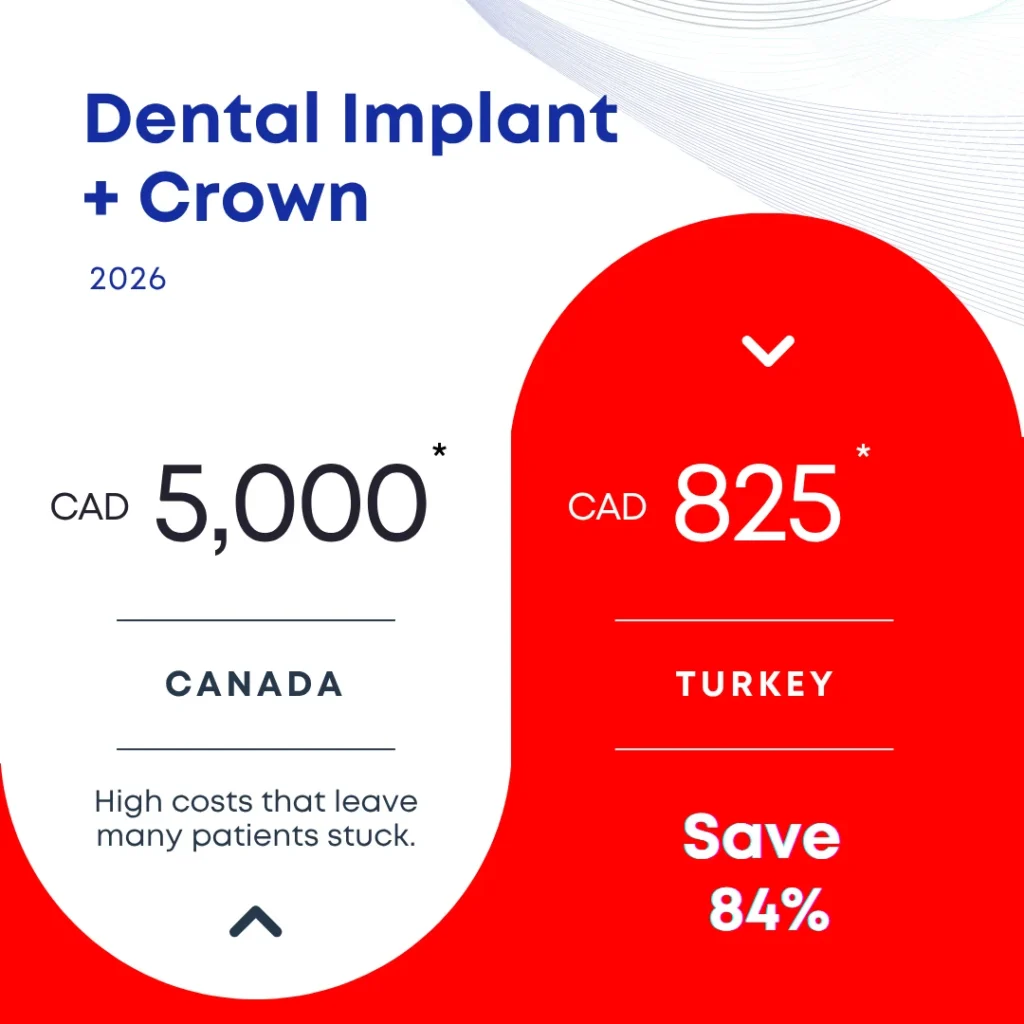
The typical turkey dental implant cost is a fraction of Canadian prices: Canadians routinely pay five times more for the same implant, with the same materials and the same expert care. The table shows typical prices for the most common treatments.
| Treatment | Turkey (from) | Canada (typical) | Saving |
|---|---|---|---|
| Single implant (implant + abutment) | CAD 550 | about CAD 3,000 | about 82% |
| Single implant with crown | CAD 825 | from CAD 5,000 | about 84% |
| All-on-4, one arch | CAD 4,200 | from CAD 25,000 | about 83% |
| All-on-6, one arch | CAD 5,380 | from CAD 35,000 | about 85% |
| Full mouth, both jaws (All-on-4 x 2) | CAD 8,400 | from CAD 50,000 | about 83% |
Across treatments, patients save up to 86%. Your final treatment plan and price should be confirmed once your dentist has reviewed your X-rays or scans. For full-arch cases, the price also depends on the type of prosthesis, how it is built and the materials used. See All-on-X Dental Implants Explained for a full breakdown.
What Your Quote Should Include
When comparing quotes, ask whether the price includes diagnostics (CBCT scans), bone grafting (if necessary), temporary teeth, customised occlusal splints, laboratory fees, medications and follow-up visits. Ask for an itemized treatment plan, so you know exactly what you are paying for and can compare like for like.
What Affects the Price of Dental Implants in Turkey
- Additional procedures: bone grafting or sinus lifts add cost and time when there is not enough bone.
- Case complexity: the number of implants and any extractions needed.
- Type of prosthesis: a single crown costs far less than a full-arch bridge.
- Implant brand and material: premium brands cost more; titanium is the standard, zirconia is a metal-free alternative.
- Laboratory quality: the lab that makes your final teeth affects both price and fit.
Also confirm payment terms, taxes, accepted currencies and whether a deposit is required to secure your appointment.
Why Dental Implants Are Out of Reach for Many Canadians
In Canada, the dental implants price for a single implant with abutment and crown starts from about CAD 5,000, before any bone grafts or sinus lifts. Behind that price are precise surgery by trained specialists, imaging, consultations and follow-up care. For a household on the median income of around $65,000, that is a heavy cost for one tooth, let alone a full mouth.
Insurance rarely closes the gap. Most private plans exclude implants or cap coverage at annual maximums as low as $1,000, often after a waiting period of six months to a year. A patient with a $5,000 implant bill might receive $1,000 from insurance and pay the remaining $4,000 themselves. Rural and remote communities face the added problem of limited access to specialist care.
The result is that many Canadians postpone treatment. Their dental problems worsen and costs rise, and they feel trapped, frustrated and helpless as their oral health declines.
What the Canadian Dental Care Plan (CDCP) Doesn’t Cover
The CDCP covers basic services for those who are eligible, such as cleanings, fillings and extractions. Dental implants, bone grafts and full-mouth restorations are excluded. A patient needing All-on-4 restoration, which can cost upwards of $50,000 in Canada, receives no help from public programs. We break down CDCP eligibility and coverage in a separate article.
Full-Mouth Dental Implants Cost in Canada: A $57,000 Case Study
The financial challenges of dental implants in Canada are not just statistics. They are real stories affecting real families, including ours.
When a Family Mortgaged Their Home for Dental Care
In 2018, the co-founder of Dental Pathways, Zahir Nathoo, faced a family dental crisis that no family should have to endure. His younger sister needed a full-mouth restoration, an All-on-4 procedure for both her upper and lower jaws, to regain her smile and oral function. The full mouth dental implants cost in Canada was staggering: $57,000. With no insurance coverage and limited savings, his dad had to take out a mortgage on the family home to pay for her treatment. The family felt trapped, desperate, and resigned to the belief that this was the only path forward.
The Shocking Discovery That Came One Year Too Late
Less than a year after the procedure, Zahir discovered that the exact same treatment, performed by highly qualified professionals in Istanbul, Turkey, would have cost about $10,500, less than a fifth of what they paid. How had they been led to believe that paying five times more was the only option? That question, and the $46,500 his family could have saved, is why Zahir and his wife Elif, who is Turkish, founded Dental Pathways: so no other Canadian family has to go through the same thing.
We believe no Canadian should pay five times more simply because of where they live. That’s why we vet clinics and specialists in Turkey, and why our process gives clear pricing with no hidden fees, so patients can make informed decisions.
– Zahir Nathoo, Founder, Dental Pathways
Zahir shares his family’s story, and the journey that led him to become a dental tourism facilitator for Canadians, in the video below.
Learn more about Zahir and Elif.
Why Dental Implants Cost Less in Turkey: Economics, Not Quality

The cost difference between Canada and Turkey is rooted in economics, not quality. Labour costs are significantly lower, clinic overheads such as rent and utilities are more affordable, and the exchange rate favours Canadian patients. The government also actively supports and promotes Turkey as a hub for medical and dental care.
None of this requires cutting corners. Turkey’s modern clinics use current technology, and many Turkish dentists have completed advanced training both locally and abroad. Patients from around the world, including thousands of Canadians, choose Turkey dental implants for this combination of quality and price.
Research backs this up. In a 2026 study of dental tourists in Türkiye, about 94% chose the country for its price advantage, 86% for shorter treatment times and 82% for trust in the dentist (ZH Keleş, Investigation of factors influencing patients’ preferences for traveling to Türkiye for dental tourism, 2026).
Price should never be the only reason to choose a clinic, though. Low prices also attract volume-driven, opportunistic clinics, which is why how you choose matters as much as where you go.
How Dental Implant Treatment in Turkey Works
A dental implant is a small titanium post placed in the jawbone, where it acts as an artificial tooth root. Once the bone has fused with it, it can hold a single crown. Together, several implants can hold a bridge or a full arch of fixed teeth. Unlike dentures, implants stay fixed in place and help preserve the jawbone, so you can eat and speak naturally.
Good candidates include people with missing teeth who want a long-term solution, patients who need full-arch rehabilitation, and people in otherwise good health. Your dentist assesses your medical history, smoking status and bone volume to confirm implants are right for you and whether any preparatory work is needed.
Before you travel, we recommend you have a remote consultation with your treating dentist using photos and X-rays or scans, and receive a written treatment plan with a cost estimate. Never get treatment from a doctor you haven’t met. In Turkey, treatment follows these steps:
- Consultation and planning: an in-clinic exam and scans to confirm the plan.
- Implant placement: the titanium implant is placed in the jawbone.
- Temporary teeth: in carefully selected cases, temporary teeth are fitted during healing (see below).
- Healing: over several months, the bone fuses with the implant (osseointegration).
- Abutment: a connector is attached to the implant to hold the crown.
- Final crown or bridge: your permanent teeth are fitted.
Bone grafting or a sinus lift may be needed first if there is not enough bone. These add time but are standard solutions. Many clinics also use digital planning and guided surgery for accuracy.
How long it takes: whether you need a single implant or a full arch, treatment usually takes two trips. On the first, your implants are placed, which takes a few days in the clinic. On the second, several months later once healing is complete, your final crown or fixed bridge is fitted. Dental Pathways helps plan your trips around these healing windows, so nothing is rushed.
Your Dental Implant Journey with Dental Pathways
Two trips to Istanbul, with planning and support at every stage.
-
Before you go
At your own pace- Enquiry
- Discovery call with Dental Pathways
- Send your X-rays, which we share with the clinic
- Dental consultation: meet your dentist
- Written treatment plan and quote
- Your decision
- Trip planning with Dental Pathways: when to go, where to stay, what to do, and our Istanbul Orientation Guide
-
Trip 1: implants placed
About 5 days -
Healing at home
About 3 months- Your implants fuse with the bone while you recover at home
-
Trip 2: final teeth fitted
About 7 to 10 daysThe length of this trip depends on how firmly your implants have set after Trip 1.
-
Aftercare
Ongoing- Support once you are home
Recovery: What to Expect After Surgery
The procedure itself is painless, as it is done under local anaesthetic. Afterwards, most patients have some swelling, bruising and soreness for the first few days, usually managed with the pain relief your dentist prescribes and cold compresses. All patients follow a soft-food diet while the implants heal, avoid smoking and alcohol, and keep the area clean as instructed. Most people are comfortable flying home a few days after surgery; if you’ve had a sinus lift, your dentist may ask you to wait a little longer.
Same-Day Teeth: When Are They Right?
With All-on-4 or All-on-6 treatment, patients often receive temporary fixed teeth on the day of surgery, which provides some aesthetic benefits while the implants heal. This can be a great option, but only when implant stability, bone quality and bite forces allow it. For some patients, not loading the implants at this stage is sometimes safer and more predictable. Read more in Teeth in a Day: The Truth About Same Day Dental Implants.
Do Implant Brands Matter?
Premium brands such as Straumann, Nobel Biocare and Zimmer Biomet are backed by decades of research, while reputable mid-range brands such as Osstem, Megagen and Neodent perform very well at a lower cost. Brand affects price, but our view is simple: a well-made implant is important, but the experience and judgement of the dentist placing it matters far more. See Why Dentist Expertise Matters More Than Dental Implant Brands.
How to Choose the Right Dental Clinic in Turkey
Turkey has hundreds of clinics offering implants, and quality varies widely. Use this checklist before you commit:
- Work with a facilitator in your home country: someone close to home who knows the Turkish clinic landscape and guides you through the whole process is one of the best ways to reduce risk.
- Qualifications and experience: confirm the dental team’s training and track record, especially in implantology, and ask to see similar cases.
- Who treats you: meet your dentist and assess his or her integrity and commitment to your case and outcome.
- Implants and equipment: make sure the clinic uses FDA-approved or CE-certified implants and current technology, such as digital planning and guided surgery.
- The dental lab: ask which lab makes your teeth. In-house labs are not always the safest choice. Clinics that work closely with well-established labs deliver more consistent results.
- A written treatment plan: you should receive an itemized plan with procedures, materials, timeline and cost before you travel.
- Safety protocols: check sterilization, infection control and emergency procedures.
- Aftercare in writing: ask how follow-up works once you are home, and get any warranty terms in writing.
- Real reviews: look for reviews with photos, timelines and detail about communication and aftercare.
Dental Pathways assesses clinics on these criteria and works only with dentist-owned clinics where you meet your treating dentist before committing. In the video below, Zahir explains how to choose a clinic for dental implants in Turkey.
For a deeper guide, read our article on how to choose a dentist in Turkey.
Safety and Aftercare When You Get Implants Abroad
Dental implants in Turkey are very safe when placed by experienced clinicians who follow established standards. Like any surgery, implants carry risks, such as infection, nerve injury or implant failure if placement or bone quality is inadequate. Good planning reduces these risks: thorough imaging before surgery, staged treatment where needed, and clear instructions on pain, swelling and the signs of a complication.
Because you will heal at home, plan your aftercare before you go:
- Follow the instructions of the dentist who places your implants for the best outcomes.
- Ask who to contact if something feels wrong after you return, and when to see a local dentist instead.
- Confirm what check-ups are necessary and whether they can be done remotely.
- Keep all treatment records, X-rays and receipts to share with your dentist at home, if ever needed.
How Dental Pathways Helps Canadians Get Dental Implants in Turkey
We are not a clinic. Dental Pathways is a Canada-based facilitator that guides you through every step:
- Clinic matching: we connect you with a vetted, dentist-owned clinic in Istanbul suited to your case.
- Direct access to your dentist: you meet your treating dentist before you commit or book travel.
- Transparent pricing: a clear, itemized treatment plan with no hidden fees.
- Trip planning: scheduling your visits around healing time, with travel and accommodation advice.
- Support throughout: before, during and after treatment, with a point of contact in your own time zone.
Learn more about our dental tourism support services.
Take Control of Your Dental Health Today
Dental care shouldn’t cost five times more just because you live in Canada. If you’re facing impossible choices or an overwhelming dental implants price, know that affordable, world-class dental implants are within reach. Let Dental Pathways guide you safely and confidently to the care you deserve.
About the Author
Elif Nathoo is a medical tourism facilitator who has worked with dental patients from Canada, the UK, and the US for over three years, helping them connect with trusted, affordable, and high-quality dental care in Turkey.
Dental Implants in Turkey: FAQs
How much do dental implants cost in Turkey?
The price of dental implants in Turkey starts from CAD 550 for a single implant with abutment, or CAD 825 with the crown. All-on-4 starts from CAD 4,200 per arch, and a full mouth (both jaws) from CAD 8,400. That is up to 86% less than in Canada, or about 70% on average after flights and hotel.
Are dental implants covered by Canadian insurance or the CDCP?
Public healthcare and the CDCP do not cover dental implants. Private insurance often excludes implants or caps coverage at low annual maximums with waiting periods, leaving most Canadians with large out-of-pocket costs.
Why are dental implants so much cheaper in Turkey?
Lower labour costs, lower clinic overheads, a favourable exchange rate and government support for medical tourism. Turkish clinics use the same implant systems and modern equipment, so the saving comes from economics, not lower quality.
Is it safe to get dental implants in Turkey?
Yes, when you choose an accredited clinic with an experienced team or work with a facilitator to guide you through the process. Implants carry risks such as infection, nerve injury or implant failure, which careful imaging, staged treatment when needed and clear aftercare instructions help reduce.
How long does treatment take, and how many trips will I need?
Treatment usually spans several months because the bone needs time to heal around the implant. Single implant as well as full-arch cases typically need a short initial trip for surgery and a return trip for the final crown or full fixed bridge.
What happens at the first consultation?
The dentist reviews your medical history, examines you and takes X-rays or scans to assess your jawbone. You have an opportunity to ask questions and you should receive a written treatment plan, cost estimate and timeline, plus a clear explanation of risks and alternatives.
How do I prepare for my trip?
Check your passport and any visa needs, gather your medical records, medication list and recent dental X-rays, and ask whether scans or blood tests can be done before you leave. Confirm your transfers, whether a translator is available, and how post-op instructions will be shared. If you work with Dental Pathways, you will be guided through this process from start to finish.
You can also visit our Dedicated FAQ Page for answers to some of the most important questions about dental tourism.