Last Updated on October 21, 2026 by Dental Pathways
By Zahir Nathoo, Medical Tourism Facilitator
Medically reviewed by Dr. Can Atakan, Dentist | October 21, 2026
Veneers in Turkey cost from CAD 215 to CAD 445 per tooth, depending on the material, against roughly CAD 1,000 to CAD 2,300 per tooth in Canada. That makes the veneer cost in Turkey up to 86% lower, or about 70% lower on average once flights and hotel are included (here’s why prices are lower in Turkey).
Most veneer articles stop there. But we think that’s where the real conversation starts!
Paying for the most expensive material or the most advertised package won’t guarantee the success of your veneer treatment. Success depends on three things a price alone doesn’t show: whether veneers are right for you in the first place, the most suitable material for your particular case (not just the priciest), and a dentist whose process is thoughtful and conservative, keeping as much of your own tooth as possible.
This guide gives you the prices first, then walks through all three considerations, guided throughout by the expert clinical view of our partner dentist in Istanbul.
Price of Veneers in Turkey (2026)
The price of veneers in Turkey depends mainly on the material. These are our partner clinic’s starting prices per tooth, in Canadian dollars.
| Material | Turkey (from, per tooth) | Canada (typical, per tooth) | Saving | Set of 10 in Turkey |
|---|---|---|---|---|
| Composite | CAD 215 | ~CAD 800 – 1,200 | ~78% | CAD 1,935 |
| Porcelain | CAD 340 | from CAD 1,800 | ~81% | CAD 3,060 |
| Zirconium | CAD 435 | ~CAD 2,300 | ~81% | CAD 3,915 |
| E-max (lithium disilicate) | CAD 445 | ~CAD 2,300 | ~81% | CAD 4,005 |
For 16 to 20 veneers (top and bottom), a set starts from CAD 4,625 to CAD 5,780 in porcelain, or CAD 6,050 to CAD 7,565 in E-max. Larger sets cost less per tooth, and your final price is confirmed once your dentist has reviewed your case.
Not every material in this table suits every patient, or every tooth. Further down, we explain which one we recommend for patients who travel, and why.
How Many Veneers Do You Need?
- 1 to 2 veneers: a single chipped, stained or misshapen tooth.
- 4 to 6 veneers: the most visible front teeth.
- 8 to 10 veneers: a standard upper set covering the “smile zone”, the teeth that show when you smile.
- 16 to 20 veneers: upper and lower sets together.
Back teeth aren’t usually included. They rarely show when you smile, and they carry heavy chewing forces that veneers aren’t designed to take.
What the Price Includes
With Dental Pathways, the per-tooth price includes your dentist’s examination and diagnostics, the digital scan, the mock-up (a trial version of your new smile), temporary veneers, materials and lab work, fillings if needed (not root canals), and VIP transfers in Istanbul.
Veneers take one trip. Five to seven days in Istanbul is usually more than enough.
Find out if veneers are right for you
Book a free consultation. We review your photos, X-rays and concerns with you, and if veneers look like a good option, we show you a preview of what your new smile could look like.
Book a Free ConsultationVeneers in Turkey Cost: What the Price Doesn’t Tell You
A quote tells you what you’ll pay on the day. What it can’t tell you is whether your veneers will still look natural in ten years, or whether they’ll start to stain, chip or come loose within two.
That comes down to three things that never appear on a price list:
- Whether veneers are right for your teeth in the first place. Some teeth are better served by aligning them first, or by treatment with crowns.
- The right material for you. Not the most expensive or the most advertised, but the one that suits your teeth and the way you’ll live with them.
- How much of your own tooth is kept. This is decided by the dentist’s skill and process, and it’s the single biggest factor in how long veneers last.
Each deserves a closer look, so let’s take them one at a time.
Are Veneers Right for Your Teeth in the First Place?
Many of the people who contact us ask for veneers by name. What they’re really asking for is a smile they feel good about, and veneers are only one way to get there. Sometimes they’re the best way. Sometimes they aren’t, and it’s far better to find that out before treatment than after.
Veneers vs. Crowns? Most People Confuse the Two
A veneer is a thin shell bonded to the front of a tooth. It changes the colour, shape or size of healthy teeth, and usually needs only minimal preparation of the enamel, sometimes none at all.
A crown, by contrast, is a cap that covers the whole tooth. Its job is to restore and protect a tooth that is broken, heavily filled or weakened, and to make room for it, the tooth has to be reduced on every side.
In Turkey, the two cost much the same: porcelain crowns start from CAD 235 per tooth, and porcelain veneers from CAD 340. The real difference isn’t the price, it’s how much of your natural tooth each one takes. If you’d like to understand crowns in more depth, our guide to dental crown costs and materials in Turkey covers prices and materials, and Crown Confusion: Dental Crowns Explained explains why the right crown depends on far more than the material.
Once that difference is clear, the rest of this guide falls into place: why veneers are sometimes the better choice and sometimes not, and why some materials belong on front teeth while others are kept for the back.
Your Dental Health Comes Before Your Smile
Veneers are cosmetic. Decay, gum disease, cracked teeth or bite problems need to be dealt with first, or the new veneers sit on a weak foundation. That’s why a proper review of your X-rays and dental history comes before any talk of shapes and shades.
The Best Veneer Candidates Have Relatively Well-Aligned Teeth
Veneers work best on front teeth that are already relatively well aligned. When teeth are crowded or badly out of line, the dentist has to remove a lot more tooth to make the veneers sit straight, and that often means cutting through the enamel into the dentine, the softer layer beneath it. As you’ll see further down, that’s exactly where veneer bonds begin to fail.
Dr. Can’s advice for misaligned teeth is clear:
If a patient wants laminate veneers on teeth that are not well aligned, the teeth should be aligned first with orthodontics, then the veneers placed, to avoid excessive preparation. If they don’t want orthodontic treatment, then full crowns are often the better approach.
– Dr. Can Atakan, Dentist
In practice, that might mean a few months of clear aligners or braces at home before you travel, so your veneers can be placed on teeth that need less preparation. If it’s a borderline case and you’d rather not go through orthodontic treatment, porcelain or zirconium crowns are usually the more honest route than heavily prepared veneers.
Your Bite Matters Too
Even well-aligned teeth can be poor candidates if the bite is working against them. A deep bite, or a habit of clenching or grinding, places forces on veneers that can crack them or weaken the bond over time. Many people grind at night without ever realising it, which is why your dentist will look for the signs. If it applies to you, a night guard may be enough to protect your veneers; in some cases, a different plan altogether is the wiser choice. You can read more in our article on bruxism and teeth grinding.
Veneer Cost in Turkey by Material: Which One Should You Choose?
The veneer cost in Turkey rises from composite through porcelain to zirconium and E-max. It’s tempting to assume the most expensive option must be the best, or that the cheapest is a sensible way to save. Neither is quite true. The right choice depends on which teeth are being treated, and how you’ll live with them afterwards.
| Material | How it’s made | Typical lifespan | Best suited to | Brands used by our partner clinic |
|---|---|---|---|---|
| Composite | Built by hand on the tooth in one visit, or 3D printed | About 4 to 8 years | Short-term or budget fixes close to home | Tetric N-Ceram (Ivoclar), G-Bond (GC) |
| Porcelain | Made in a dental lab | 10 to 15 years, often 20+ with care | Front teeth, at a lower price than E-max | Ivoclar Vivadent |
| Zirconium | Made in a dental lab; needs extra thickness to look natural | Long-lasting on back teeth; not used for front veneers | Back teeth (inlays, onlays, occlusal veneers), not front veneers | Nacera zirconium, GC porcelain |
| E-max (lithium disilicate) | Made in a dental lab | 10 to 15 years, often 20+ with care | Front teeth: the strongest bond to enamel and the most natural look | IPS e.max (Ivoclar Vivadent) |
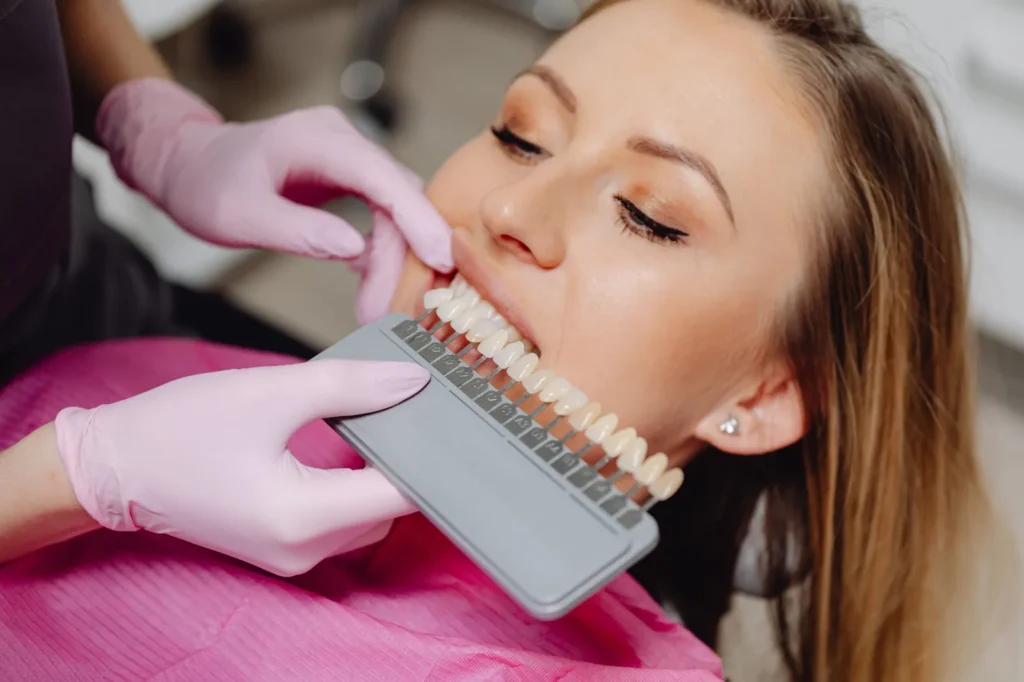
What We Recommend for Patients Who Travel
For front-teeth veneers, Dr. Can recommends E-max:
When a health tourism patient is travelling across the world for laminate veneers, the correct material is E-max. Not composite, not zirconium.
– Dr. Can Atakan, Dentist
E-max bonds best to enamel and looks the most like natural teeth. Porcelain, the grade just below it, is also a great option for patients who want to keep the cost down.
Why not zirconium for front teeth? Zirconium is a remarkably strong material, stronger than E-max when it’s thick enough, which is why it’s the right choice for back teeth that take the full force of chewing. On front teeth, though, that thickness becomes a problem. To look natural, zirconium needs more room, which means removing more of your tooth, and even then it doesn’t match the natural look of E-max. For that reason, Dr. Can doesn’t use zirconium for front veneers.
Why not composite if you’re travelling? Composite veneers are the most affordable option, and they do have their place, for example as a short-term or budget fix close to home. But composite tends to stain at the edges within months, needs professional polishing roughly every six months, and the printed version can break easily. We have arranged composite bonding for some patients, and we always make sure they know about the upkeep involved. For most people, though, flying across the world for a material that needs that much attention once you’re back home simply doesn’t make sense.
The Material Matters, but the Bond Matters More
Choosing the right material is only half the story, because even E-max will fail if it’s bonded to the wrong surface. A large review of porcelain veneer studies found that about 95% were still working after ten years, and that the best results came when veneers were bonded to enamel rather than dentine (Alenezi et al., 2021). Which brings us to the factor that matters more than any other.
What Are “Turkey Teeth”? Why Shaving Too Much Makes Veneers Fail
“Turkey teeth” began as British social media slang around 2021 and 2022, when a wave of reality TV stars came home from Turkey with dramatic new smiles. The phrase has since come to describe two things that usually go hand in hand:
- The look: a full arch, often a full mouth, of large, opaque, uniformly bright white teeth that don’t look natural.
- The damage underneath: in many of the cases that went viral, healthy teeth had been filed down to small pegs for full crowns, when the patients believed they were getting veneers.
While the look can be redone, the enamel that has been filed away can’t come back. In a BBC survey of 1,000 UK dentists, 597 said they had treated patients for complications after dental work in Turkey (NationalWorld).
Turkey has many excellent dentists. The problem isn’t the country; it’s the large, opportunistic clinics that put volume ahead of long-term patient outcomes. They cut corners by rushing the preparation and shaving away more tooth than the result needs. The smile may look impressive on the day you fly home, but the cost shows up later.
How much of your tooth does each treatment remove?
A front tooth seen from the side. The blue shows how much tooth was removed and replaced. Veneers last longest when the preparation stays in the enamel.
Why Your Enamel Is the Key to Veneers That Last
Enamel is the hard outer layer of your tooth. Dentine is the softer layer underneath. Veneers are bonded to the tooth with adhesive systems that work best, and hold strongest, on enamel, not dentine.
The key to long-term success for laminate veneers is that the preparation has to finish on the enamel layer, especially at the borders. It mustn’t enter the dentine, because the bonding systems work best on enamel.
– Dr. Can Atakan, Dentist
When the edges of a veneer sit on exposed dentine, Dr. Can sees the same chain of problems again and again:
- sensitivity, because the tiny tubes in dentine are open to the mouth
- a weaker bond
- staining along the edges over time
- decay at the edges
- veneers coming loose or falling off
This is why minimal-preparation and no-preparation veneers have the best long-term record. The less healthy tooth that’s removed, the more enamel there is to bond to, and the longer your veneers are likely to last.
Your Dentist Makes the Difference
If there’s one thing we’ve learned from working with patients, it’s that the success of veneers is decided long before the final shells are bonded in place. It’s decided in the chair, in that first conversation, by a dentist who takes the time to understand your teeth, your bite and what you’re hoping for, and who has the experience to know how little needs to be removed to get you there.
That’s where many high-volume clinics fall short. When a business is built on throughput, almost every veneer enquiry becomes a veneer case. Patients whose teeth would have been better aligned first are prepared anyway. Others need so much shaving to reach the look they’ve been promised that crowns would have been the more honest recommendation. And sometimes, through inexperience or simply a rushed schedule, too much tooth is removed. On the day you fly home, the smile can look perfect. The problems tend to surface a few years later, when they’re much harder, and more expensive, to put right.
So if a dentist ever tells you that veneers aren’t the right treatment for you, don’t be discouraged. It’s often the clearest sign you’re in good hands.
Can Bad Veneers Be Replaced?
Yes, though it depends on why they failed in the first place, and that’s always the first thing Dr. Can wants to understand:
- Too much preparation the first time: if the previous dentist cut into the dentine, new veneers won’t bond well either, and full crowns may be the better option going forward.
- Veneers were the wrong treatment: if the teeth needed aligning first, that may still need to happen.
- The preparation was sound: if the veneers are simply old, or you want a different shape, they can be removed and replaced with new ones.
Every case is different, so the answer starts with your X-rays and a careful look at the work that’s already been done.
How We Do Veneers: Your Dentist Designs Your Smile With You
Our process is built around one idea: you and your dentist agree on what’s needed, and on the result, before any tooth is touched. The X-rays you send from home, together with an in-person clinical review in Istanbul, shape your treatment plan. Only the teeth that truly need preparation are prepared, and only as much as the result requires.
Before You Travel
- A free consultation. We review your photos, X-rays, dental history and what you’d like to change. These, not a picture of a smile, decide whether veneers are a sensible option, or whether alignment, crowns or other treatment should come first. You also meet your dentist on a video call before you book anything.
- A smile preview, if veneers look right. When the diagnostics point to veneers as a possible treatment, we can show you a rough preview of what your smile could look like. It’s a starting point for the conversation, not a clinical plan. Smile apps you can download work the same way: good for motivation, not for planning treatment.
Your Treatment Timeline in Istanbul
Five to seven days is more than enough for a full veneer treatment in Istanbul.
- Day 1, morning: consultation and scan. Your dentist talks through your expectations, then takes a digital scan of your teeth. Nothing is shaved. The scan goes to the lab in seconds.
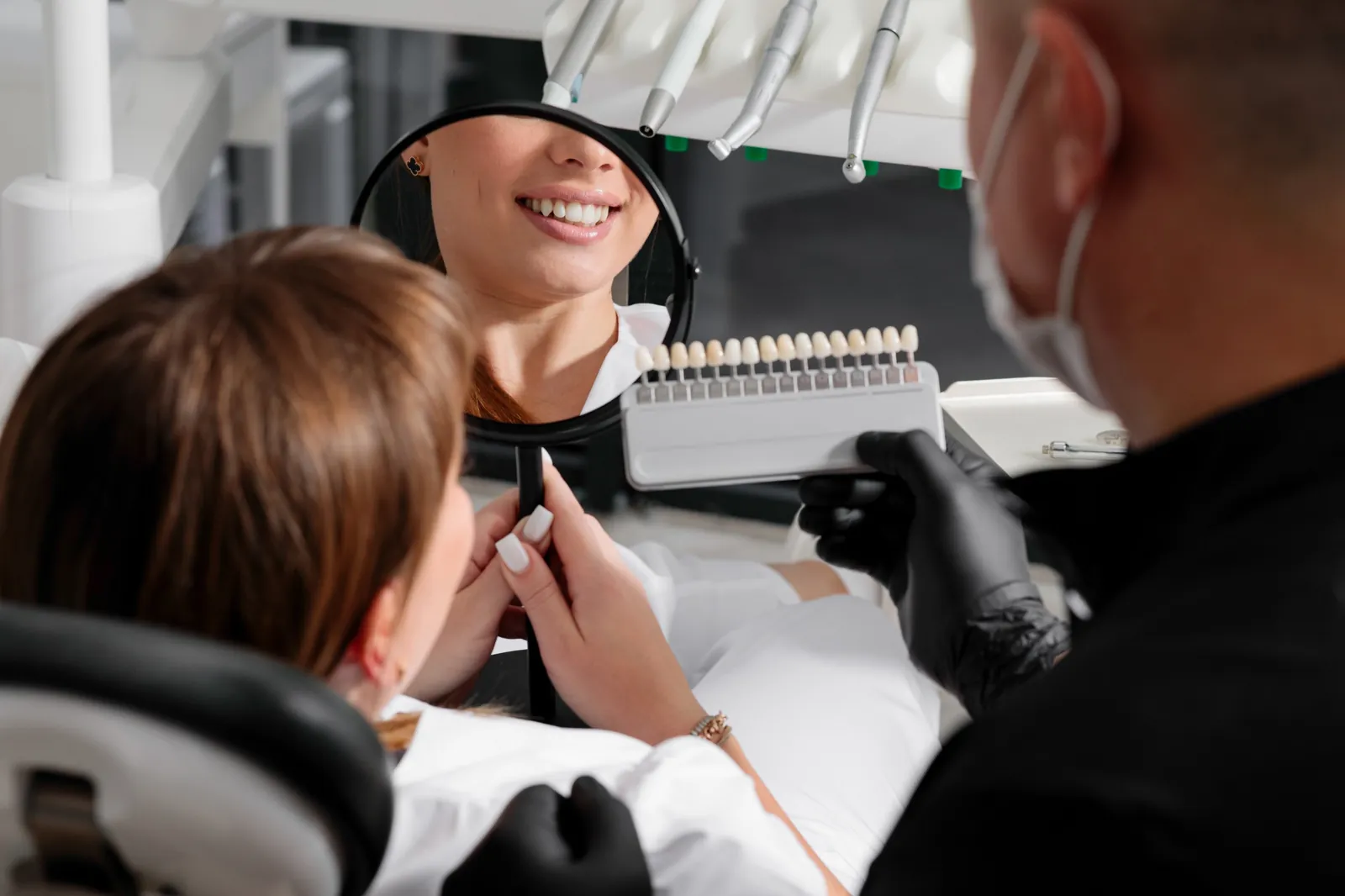
- Day 1, afternoon: the mock-up. The lab sends back a mock-up, a 3D-printed trial version of your new smile, made from the design agreed during your consultation. It’s fitted over your own teeth so you can see and feel the result.
- Designing it together. This is where the real work happens. Do you want your canines rounder or straighter? Your front teeth a little longer, or more visible when you talk? Dr. Can can add composite to the mock-up to show you how larger teeth would look. You look in the mirror, ask questions, change your mind. Nothing is final until you’re both happy.
- Preparing through the mock-up. The mock-up also shows your dentist exactly where, and how much, to prepare. Dr. Can prepares through it, so he removes only the space the E-max needs, and keeps the preparation on enamel.
- Impressions and temporaries. After minimal preparation, new impressions go to the lab and you wear temporary veneers while the lab produces your finals.
- Fitting and bonding. The lab makes your final veneers in three to four days. After a fitting session to check shape, shade and bite, they’re bonded in place.
Not every clinic shows you a mock-up before preparing your teeth, which makes it one of the most useful questions you can ask.
Looking After Your Veneers
Brush and floss as normal with a soft brush and non-abrasive toothpaste, avoid biting very hard foods with your front teeth, and keep up regular check-ups at home. If you grind or clench, wear the night guard your dentist recommends. We always stay in touch with our patients after they return home; see how we support you before, during and after treatment.
How to Compare Veneer Quotes Like for Like
Search “veneers Turkey cost” and you’ll find package prices that vary enormously. Before you compare them, make sure each quote tells you:
- how many teeth are included, and which ones
- the material and brand, in writing
- which lab makes the veneers
- whether a mock-up and temporary veneers are included
- what’s included beyond the veneers: diagnostics, fillings, transfers, aftercare
A package that looks cheaper often covers fewer teeth, uses a lower-grade material, or quietly skips the steps that protect your teeth. If you’ve received quotes that seem impossible to compare, our guide on how to read and compare dental treatment plans in Turkey can help. And if you’re wondering why prices for the same treatment vary so widely, we explain it in why dental treatment prices in Turkey can be confusing.
Questions That Test a Clinic Before Anyone Drills
The best question is the simplest: “What is your process, and what makes veneers last?” If the answer covers keeping preparation on enamel, checking your alignment and bite, and showing you a mock-up first, you’re talking to the right people. If it’s mostly a sales pitch about price, speed or ‘premium’ materials, keep looking.
Then ask:
- Will I see a mock-up of my new smile before you prepare my teeth?
- How much of my teeth will you remove, and will the edges stay on enamel?
- Are my teeth aligned well enough for veneers, or would aligners or crowns be better?
- Which material do you recommend for my front teeth, and why?
- Who is my dentist, and can I speak with them before I travel?
- What happens if a veneer chips or comes loose after I’m home?
Watch for these warning signs:
- a price before anyone has looked at your X-rays
- the same package offered to everyone
- no one ever suggesting that veneers might not be right for you
- no direct contact with the dentist before you travel
- talk of shade and “Hollywood smiles” before any talk of your dental health
Before we work with any clinic, we ask these same questions ourselves. In this short video, Zahir explains what he looks for when choosing a dental clinic in Turkey, and what you should look for too.
For more on what to look for in a clinic, especially for cosmetic work, see how international patients choose the best dental clinic in Istanbul.
Find Out If Veneers Are Right for You
The savings on veneers in Turkey are genuine, and for many of our patients they’re what makes treatment possible at all. But the decisions that matter most come long before the price: whether veneers suit your teeth, which material suits you, and who prepares them.
We would much rather help you make those decisions well than sell you a set of veneers. That’s why our first step is always a free consultation. We’ll review your photos, X-rays and concerns with you, tell you honestly whether veneers are the right treatment, and if they are, show you a preview of what your new smile could look like.
About the Author
Zahir Nathoo is a medical tourism facilitator who has worked with dental patients from Canada, the UK and the US for over two years, connecting them with trusted, high-quality dental care in Turkey. He co-founded Dental Pathways with his wife Elif after his own family paid five times more for dental treatment in Canada.
Veneers in Turkey: FAQs
How much are veneers in Turkey?
Veneers in Turkey start from CAD 215 per tooth for composite, CAD 340 for porcelain, CAD 435 for zirconium and CAD 445 for E-max. That’s up to 86% less than in Canada, or about 70% less on average after flights and hotel.
How much is a full set of veneers in Turkey?
A standard upper set of 10 veneers starts from CAD 3,060 in porcelain or CAD 4,005 in E-max. A full set of 16 to 20 veneers, top and bottom, starts from CAD 4,625 in porcelain or CAD 6,050 in E-max.
What is the best material for veneers?
For front teeth, E-max: it bonds best to enamel and looks the most natural. Porcelain is a good lower-cost alternative. Our partner dentist doesn’t recommend zirconium for front veneers, or composite for patients who travel, because composite stains and needs polishing every six months.
What determines whether veneers succeed?
Three things: whether veneers are right for your teeth in the first place, the right material for you, and how much of your own tooth is kept. Veneers bonded to enamel, with minimal preparation, last the longest.
What are the risks of veneers?
The main risks come from removing too much tooth: sensitivity, a weak bond, staining and decay at the edges, and veneers coming loose. A deep bite or teeth grinding can also break veneers. Careful planning and minimal preparation reduce these risks.
How long do veneers last?
Porcelain and E-max veneers usually last 10 to 15 years, often 20 or more with good care. Composite veneers last about 4 to 8 years.
What are 'Turkey teeth'?
A term for over-white, oversized smiles from low-cost treatment abroad, where healthy teeth were often filed down for crowns sold as veneers. The cause is excessive tooth preparation, not the country.
Can veneers be replaced in Turkey?
Yes. If the original preparation was sound, old veneers can be removed and replaced. If the previous dentist removed too much tooth, crowns may be the better option, and misaligned teeth may need aligning first.
Are crowns or veneers more expensive?
In Turkey, porcelain crowns start from CAD 235 per tooth and porcelain veneers from CAD 340. But crowns remove far more tooth, so price shouldn’t decide between them: your teeth should.
How long do I need to stay in Istanbul for veneers?
One trip. Five days is usually enough, and seven is more than enough.
You can also visit our Dedicated FAQ Page for answers to some of the most important questions about dental tourism.